
- Planning authority
- Fenland District Council
- Postcodes
- PE15
- Noon sun, 21 March
- About 37°
- Shadow from a 5 m eaves line
- About 6.5 m
- Planning plan
- Local Plan
- County
- Cambridgeshire
What shapes a plot in March
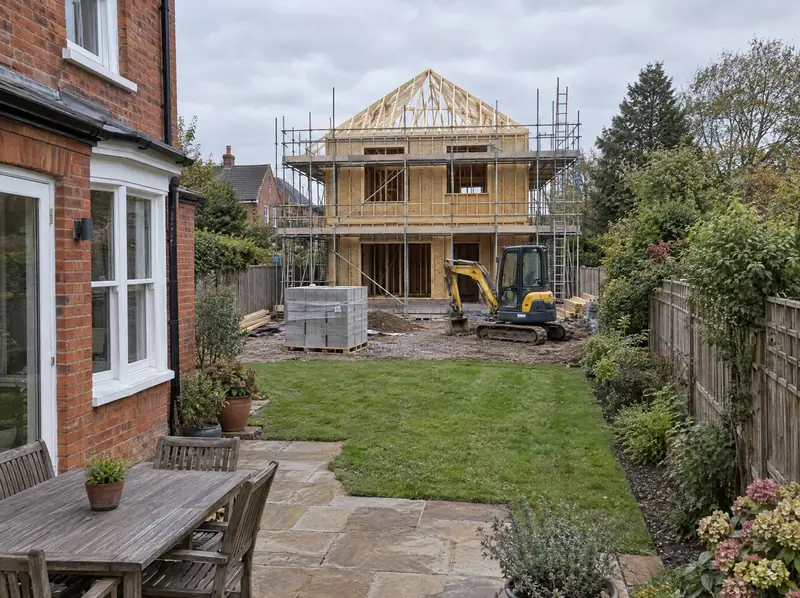
Daylight is one of the first things Fenland District Council will check on a garden house. At midday on 21 March the sun in March stands roughly 37° above the horizon, so an eaves line about 5 m high casts a shadow of around 6.5 m. On 21 December the sun is only about 14° up and shadows stretch far longer.
That’s why the gap between your house and the new one, and the height of the new roof, are set by measurement rather than guesswork. A lower eaves line, a hipped roof or a single-storey section can make a real difference to the gardens either side.
The next steps, locally
Once you ask for an appraisal of your March garden, we start with the paperwork: the title plan, any covenants, flood maps, tree and conservation designations, and planning decisions on nearby plots. A short call follows, then a site visit if the plot passes the desk check. You get our straight view of what’s realistic and what happens next, with no obligation to go further.
Free plot appraisal
We check the title plan, access, constraints and planning policy from our desk, talk the plot through with you, and visit if it looks viable. There’s no cost and no obligation.
Survey and design
A measured survey records levels, boundaries, trees and neighbouring windows. We then design a layout and house that suit the plot, the street and your budget, and decide whether pre-application advice is worth seeking.
Written quote and build
Once design and survey are complete you get a written quote. The build runs in stages — access and groundworks, foundations, frame and roof, fit-out and external works — with inspections at each key point.
Handover
You receive the completion certificate, warranty documents, Energy Performance Certificate, manuals and utility details, so the new home is ready to move into, let or put on the market.
Worth checking early
- You fund the build and carry the cost risk; ground conditions, sewer diversions or supply upgrades found later can move the price.
- Building and selling a new home can change your tax position compared with selling only your house; take advice from a tax adviser first.
- A build next door means months of noise, deliveries and contractors near your home; good planning reduces the disruption but doesn’t remove it.
March: questions to ask
Who decides planning for a garden house in March?
Fenland District Council decides applications for addresses in March, using the council’s Local Plan, national policy and its own design guidance. Neighbours and consultees such as highways officers can comment, and the decision is made by the council’s planning officers or, where the rules allow, its planning committee. Pre-application advice from the council can help test a scheme before the formal application is submitted.
Will I pay Community Infrastructure Levy on a new home in March?
Only if Fenland District Council has adopted a Community Infrastructure Levy charging schedule; not every council has. Where it applies, it can be charged on a new home of any size. A self-build exemption exists for people building a home to live in, but it must be claimed before work starts, so we check the position at design stage.
Do you visit gardens in March before giving advice?
We start with a desk review of the title plan, access, constraints and planning policy, then talk the plot through with you. If it looks viable, we arrange a site visit to see the access, levels, trees and neighbouring windows for ourselves. The appraisal is free and carries no obligation.
Can I build a house in my March garden and then sell it?
Yes. You keep the land while the home is built, then sell the finished house. Before building starts, the plot should be given its own title through a transfer of part at HM Land Registry, and if your house is mortgaged your lender must agree to release the plot. Selling a home you’ve built can change your tax position, so take advice from a tax adviser first.
Other options in March
- Garden plot option agreement
- Sell subject to planning
- Planning permission for a garden plot
- Plot feasibility and design
- Large rear gardens
- Sell part of your garden