
On this page
- What does combining gardens with your neighbours mean?
- Why can one shared access road make a better scheme?
- How is value shared fairly when only one garden gives the access?
- What goes into a collaboration agreement?
- What happens if one neighbour drops out?
- Does each owner keep their house, and what changes on each title?
- Why does each owner need their own solicitor?
- Which route suits a combined site: a sale, an option or promotion?
- Step by step
- Questions
Who this suits
- Neighbours with long back gardens where no single garden has room for its own access
- Owners whose garden plot is landlocked behind houses with no route to the road
- A household with a wide side garden that could become the shared access
- Neighbours who have already talked about selling the ends of their gardens
- Owners who would rather be part of one planned scheme than several piecemeal ones
What does combining gardens with your neighbours mean?
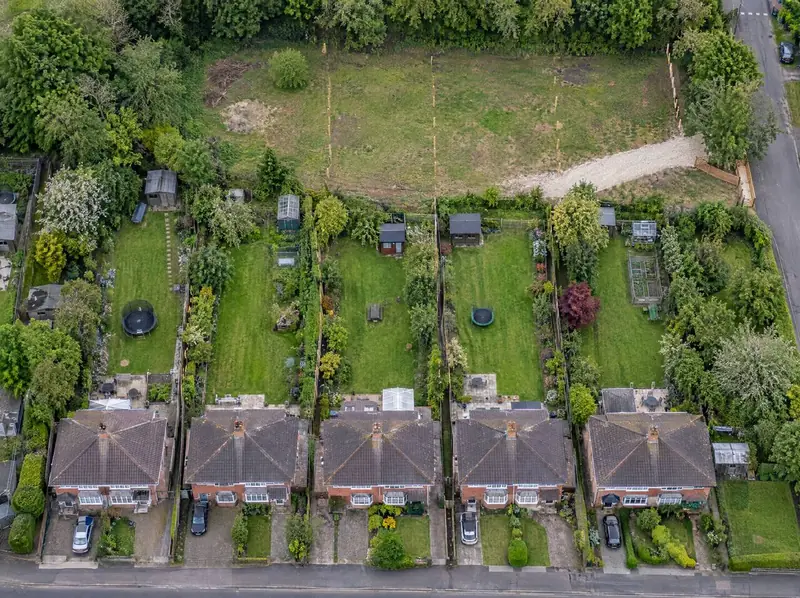
Combining gardens means two or more neighbours put the far ends of their adjoining back gardens together, so the land can be planned, approved and sold as one site. It’s often called land assembly. Each owner keeps their own house and a garden for it, and the land behind becomes one building site with one shared access.
It’s different from each neighbour selling a plot separately. Several separate plots often mean several narrow drives squeezed past houses, new homes tucked into awkward corners, and a council judging each application on its own. One combined site can be designed properly from the start, with homes placed where they cause least overlooking and one access serving all of them.
Why can one shared access road make a better scheme?
Access is the problem on most backland plots, and sharing it is often the solution. A single long garden may have no route to the road at all, or only a gap beside the house too narrow for cars, bins and emergency vehicles. If one neighbour has a wider side garden, or a garage that could come down, that one opening can serve the whole combined site.
One well-designed access road is usually easier for a council to accept than several cramped drives. It can be laid out with proper visibility at the pavement, kept further from neighbours’ windows, and planted to soften the effect of passing cars. It can also bring the bin collection point and emergency access closer to the new homes. As a guide, residents shouldn’t have to carry rubbish more than 30 metres to the bin store, and the collection vehicle should be able to get within about 25 metres of it.
Emergency access and fire safety matter as well. The scheme has to allow for fire engine access (or other measures, often sprinklers, agreed with building control and the fire service where a fire engine can’t get close enough), and a wider shared road usually gives more room to plan for that than a narrow drive beside a house.
In Wales Emergency access and fire safety matter as well. The scheme has to allow for sprinklers, which every new home in Wales must have, and a wider shared road usually gives more room to plan for that than a narrow drive beside a house.
How is value shared fairly when only one garden gives the access?
Value is shared through equalisation: the neighbours agree in advance how the total proceeds will be divided, whichever garden ends up with the road, the new homes or the open space. Without that, the owner of the access garden holds what is in effect a ransom strip, and the others hold land that is worth little without it. Equalisation stops anyone gaining or losing simply because of where the planners put the road.
There’s no single formula. Shares are often based on the area of land each owner puts in, adjusted by agreement. The owner whose garden carries the access road frequently receives an extra agreed amount, because their house is the one most affected by cars passing and their land is what makes the scheme work. For example, three neighbours might share in proportion to the land each contributes, plus an agreed sum to the owner giving up their side garden for the road. What matters is that everyone agrees the method in writing before planning starts.
What goes into a collaboration agreement?
A collaboration agreement is the contract between the neighbours, and usually with us, that binds the combined scheme together. It sits alongside the agreement under which the land is sold, optioned or promoted. Your solicitor will explain it in full, but it normally covers:
- Sign nothing until every owner has seen the whole set of documents, not just their own part
- Check that the agreement works for a buyer of your house as well as for you
- Make sure the share method is fixed before planning, not left to be agreed once values are known
| Topic | What the agreement settles |
|---|---|
| Shares | How the total proceeds are divided, including any extra for the access garden |
| Decisions | How the owners agree the scheme, the buyer and the price, and what needs everyone’s consent |
| Costs | Who pays what, and the cap on each owner’s reasonable legal fees where we cover them |
| Drop-outs | What happens if an owner wants to leave, sells their house or dies during the agreement |
| Each house | New boundaries, garden left for each home, fencing and any rights over the shared road |
| Disputes | How disagreements are settled, often by an independent expert |
What happens if one neighbour drops out?
Before anyone signs, a neighbour can simply decide not to take part, and the scheme is redesigned around the remaining gardens if that still works. If the garden that gives the access drops out, the scheme may not work at all, which is why we look at access first and talk to that owner early.
After signing, the position depends on what the agreements say. They are usually protected by an entry on each title, so they bind whoever owns the house next, and a buyer would take the house subject to them. The collaboration agreement should also cover what happens if an owner dies, and whether an owner can leave and on what terms. Your solicitor will check those clauses carefully, because they decide whether one person’s change of plan can stop everyone else.
Sometimes the honest answer is that a combined scheme works only if a particular neighbour is in. We’ll tell you that at the appraisal rather than after months of work.
Does each owner keep their house, and what changes on each title?
Yes. Each owner keeps their house and a garden for it. What changes is the land behind. When the scheme completes, each owner transfers the agreed part of their garden as a transfer of part at HM Land Registry, and the combined land becomes the new site with its own title.
Each owner’s position is checked separately. If a house is mortgaged, that owner’s lender must agree to release the land from its charge. Each title is also checked for restrictive covenants that could stop or limit building, which can sometimes be dealt with by indemnity insurance, agreement with the person who benefits, or an application to the Upper Tribunal (Lands Chamber). New boundary fences and the garden space left for each house are agreed as part of the design.
Why does each owner need their own solicitor?
Each owner needs their own solicitor because their interests aren’t identical. One owner may give the access, another may have a mortgage, a third may be planning to move, and each will have a different title, a different garden size and a different tax position. One solicitor acting for everyone can’t properly protect each of them.
Where the land goes into an option or promotion agreement with us, we cover each owner’s reasonable legal fees up to the cap agreed in the heads of terms. Tax is personal too. Private Residence Relief can cover part of a garden sold while you still own and live in the house, within a permitted area, but circumstances differ between neighbours, so each owner should take advice from a tax adviser.
Which route suits a combined site: a sale, an option or promotion?
A combined site can use any of our sell-or-partner routes, and the right one depends on how certain the planning position is and how much the owners want to share in the result:
- Sell your garden: we buy the combined land, subject to survey, title and contract, with or without planning
- Sell subject to planning: price or formula agreed now, we normally fund planning, completion only if permission is granted
- Option agreement: we hold the right to buy the combined land once planning is secured
- Planning promotion: we seek planning at our cost and, if it is granted, the site is marketed; costs and our fee come from the proceeds
- Joint venture: the owners put in the land and share in the homes built or their sale
Step by step
Free appraisal of the combined land
We look at all the titles together, the possible access points, the surrounding homes and the planning policies that apply, then explain whether a combined scheme looks realistic and roughly what it might allow.
Meet the neighbours
We meet the owners together or separately, explain how the scheme and the routes work, and answer questions. We don’t approach your neighbours without your agreement, and nobody is committed at this stage.
Agree how value is shared
Heads of terms set out the route, each owner’s share, any extra for the garden providing the access, what happens if someone drops out, and the cap on each owner’s reasonable legal fees where it applies.
Collaboration agreement
Each owner’s own solicitor reviews the documents, and everyone signs a collaboration agreement alongside the sale, option or promotion agreement. Mortgage lenders are asked to consent early, and the agreements are usually protected on each title.
One planning application
We prepare and submit a single application for the whole site, with one shared access and a layout designed around all the existing homes. The council decides it, and nobody can promise the result.
Completion and shares paid
When the site is sold with planning, or bought by us as agreed, each owner transfers their part, and the proceeds are divided through the solicitors exactly as the collaboration agreement sets out.
Things to weigh up
- Several owners have to agree, so a combined scheme usually takes longer to set up than a single plot.
- If the garden providing the access drops out before signing, the whole scheme may not work.
- The owner of the access garden will live beside a shared road, which is why that garden often receives an extra share.
- Every owner’s mortgage lender, title and covenants have to be dealt with, and one problem can hold up everyone.
- Tax depends on each owner’s circumstances, so each should take advice from a tax adviser.
- Planning is still the council’s decision; a combined scheme is often stronger, but it can still be refused.
Questions about combine neighbours’ gardens
Do all my neighbours have to take part?
No. A combined scheme only needs the gardens that make a workable site, and the one that provides the access matters most. Two neighbours can be enough. We look at the titles and the access first, then tell you which gardens are essential, which would improve the scheme, and which make little difference.
Will you approach my neighbours for me?
Only if you want us to. Some owners prefer to raise it themselves first, others would rather we write to or meet the neighbours. Either way, we explain the scheme and the routes plainly, nobody is pressured, and nobody is committed until they’ve taken advice from their own solicitor and signed.
How do we decide who gets what?
Through an equalisation method agreed in the collaboration agreement before planning starts. Shares are often based on the land each owner contributes, adjusted by agreement, with an extra amount for the garden that carries the access road. The point is that the division doesn’t depend on where the council lets the new homes or road go.
What if a neighbour sells their house during the agreement?
If the agreements are protected on that owner’s title, as they usually are, a buyer takes the house subject to them, and the scheme carries on. The collaboration agreement should say so clearly. Owners who expect to move should tell everyone early, so their solicitor can make sure the arrangement works for a future buyer.
Is a combined scheme more likely to get planning?
It often makes a better scheme, with one proper access, more space between old and new homes, and a layout designed as a whole rather than plot by plot. Councils judge each application on its merits, though, so planning is never certain. We test the combined layout against the council’s policies before anything is submitted.
Who pays for planning on a combined site?
That depends on the route. On a sale subject to planning we normally fund the application, with any cost recovery agreed in heads of terms. On planning promotion there’s nothing to pay upfront, and planning costs are recovered from the proceeds only if a sale with planning happens. Each owner’s reasonable legal fees are covered up to a cap on option and promotion agreements.
Does a combined scheme affect each owner’s tax?
Possibly, and differently for each owner. Private Residence Relief can cover part of a garden sold while you still own and live in the house, within a permitted area, generally up to half a hectare including the house. How you share in the scheme, and when you sell, can change the position. Each owner should take advice from a tax adviser.
Who looks after the shared access road afterwards?
That’s settled before completion. Often the road is owned with the new homes, with rights of way for anyone who needs them, and a maintenance arrangement or management company shares the upkeep between the homes that use it. Where an existing house keeps using part of the road, its share of upkeep is set out in writing.