
- Nation
- Wales
- National planning policy
- Planning Policy Wales
- Planning authorities
- 2
- City
- Bangor
Gwynedd: the planning picture
Surface water is a design question on every garden build in Gwynedd, not an afterthought. A new roof and drive send rain somewhere, so the scheme will need approval from the SuDS Approval Body (SAB) before building starts. Foul drainage raises a different issue: the new home must connect to a sewer, and where a public sewer crosses the plot, the water company may need a build-over agreement. We check sewer records and ground levels at appraisal, because a sewer that sits too high or in the wrong place can move the house.
Planning authorities covering Gwynedd include Gwynedd Council, Isle of Anglesey County Council.
How it works
Free plot appraisal
We check the title plan, access, constraints and planning policy from our desk, talk the plot through with you, and visit if it looks viable. There’s no cost and no obligation.
Survey and design
A measured survey records levels, boundaries, trees and neighbouring windows. We then design a layout and house that suit the plot, the street and your budget, and decide whether pre-application advice is worth seeking.
Planning and approvals
We submit the planning application and manage it to a decision, then deal with conditions, Building Regulations approval, the structural warranty, any build-over agreement and the new utility connections.
Written quote and build
Once design and survey are complete you get a written quote. The build runs in stages — access and groundworks, foundations, frame and roof, fit-out and external works — with inspections at each key point.
Handover
You receive the completion certificate, warranty documents, Energy Performance Certificate, manuals and utility details, so the new home is ready to move into, let or put on the market.
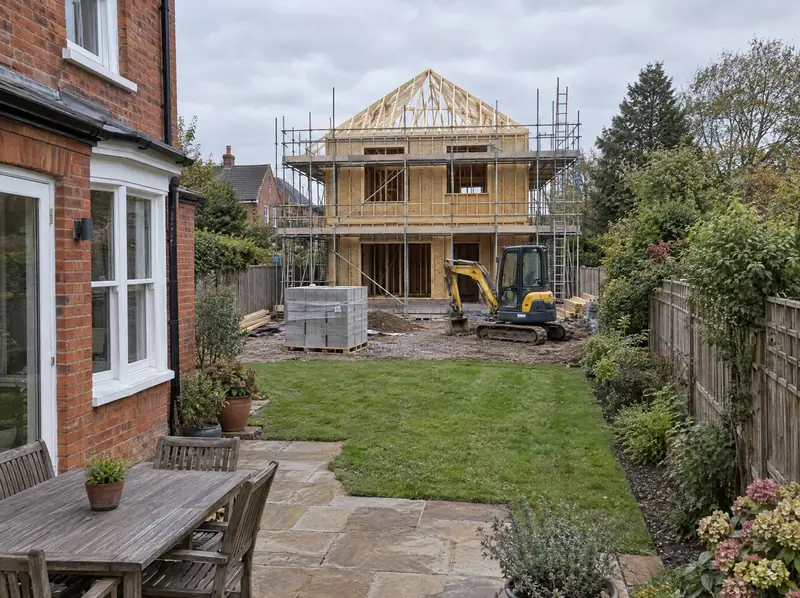
Build in your garden in towns across Gwynedd
Questions about build in your garden in Gwynedd
How is rainwater dealt with in Gwynedd garden plots?
Rain from the new roof and drive must be managed on site, and for a new home that usually means approval from the SuDS Approval Body (SAB) before building starts. Soakaways, permeable paving, rain gardens or a controlled outflow are the usual options, depending on ground conditions and flood risk. We look at levels and soil at survey stage so the drainage design fits the plot.
What fire safety rules affect a garden house in the Gwynedd area?
Building control will look for sprinklers, which every new home in Wales must have. On plots reached by a long or narrow drive this often shapes the layout, so we settle the fire strategy during design rather than after planning. Bin storage distances, access width and turning space are checked at the same stage, because each one can move the house.
Do Gwynedd planning rules allow new homes in back gardens?
There’s no blanket ban. National policy in Wales (PPW) and the local LDP set the tests: access, character, privacy, daylight, garden space, trees, parking and drainage. A home that respects the street and its neighbours has a fair hearing; one squeezed onto too small a plot is likely to struggle. Even a well-designed scheme depends on the council’s decision.
How long does planning take for a garden plot in Gwynedd?
The council usually has eight weeks from validation to decide a small application, though extensions are often agreed, and the whole process takes longer. Surveys, design work, pre-application advice and amendments all add time, and some ecology surveys can only be done at certain times of year. We’ll give you a realistic timetable for your plot rather than a promise.