
- Planning authority
- Isle of Wight Council
- Postcodes
- PO33, PO34
- Noon sun, 21 March
- About 39°
- Shadow from a 5 m eaves line
- About 6.1 m
- Planning plan
- Local Plan
- County
- Isle of Wight
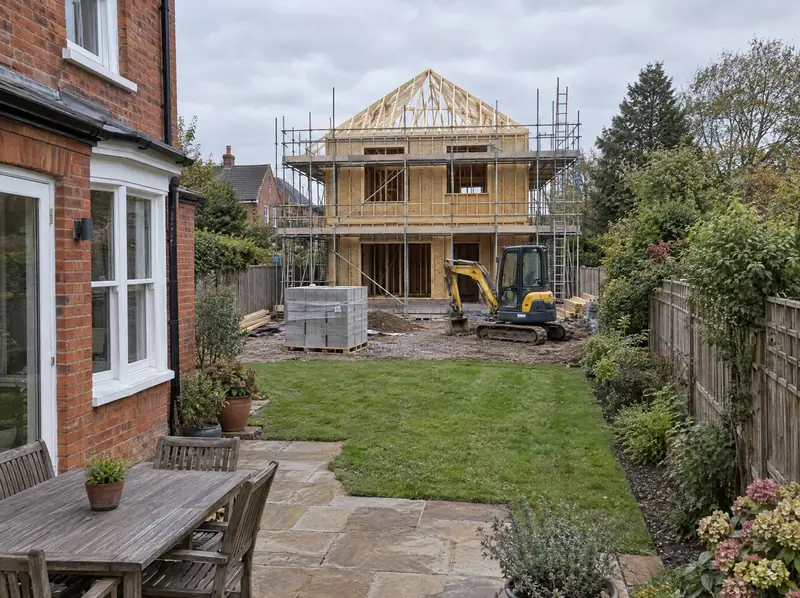
What shapes a plot in Ryde
Wherever your house sits across PO33 and PO34, a new home behind it needs water, power and two kinds of drainage — one for waste, one for rain. We contact the utility providers early, because a long cable run, a sewer at the wrong depth or a public pipe under the lawn can change both the layout and the cost.
Rain from the new roof and drive has to be dealt with on site, and Isle of Wight Council will want to see how. Where a public sewer crosses your garden, the water company may also need a build-over agreement before work starts, so we check sewer records at appraisal stage.
The next steps, locally
From appraisal to a decision from Isle of Wight Council, each step in Ryde is agreed before it starts. After the site visit we quote for survey and design; after design we prepare the application; after permission we deal with conditions and technical approvals and give you a written build quote. Each stage is a separate decision for you, with its cost set out first.
Free plot appraisal
We check the title plan, access, constraints and planning policy from our desk, talk the plot through with you, and visit if it looks viable. There’s no cost and no obligation.
Survey and design
A measured survey records levels, boundaries, trees and neighbouring windows. We then design a layout and house that suit the plot, the street and your budget, and decide whether pre-application advice is worth seeking.
Written quote and build
Once design and survey are complete you get a written quote. The build runs in stages — access and groundworks, foundations, frame and roof, fit-out and external works — with inspections at each key point.
Handover
You receive the completion certificate, warranty documents, Energy Performance Certificate, manuals and utility details, so the new home is ready to move into, let or put on the market.
Worth checking early
- A build next door means months of noise, deliveries and contractors near your home; good planning reduces the disruption but doesn’t remove it.
- Building and selling a new home can change your tax position compared with selling only your house; take advice from a tax adviser first.
- Planning can be refused, and money spent on surveys, design and the application isn’t recovered if it is — which is why we start with an appraisal.
Ryde: questions to ask
How long does planning take for a new home in a Ryde garden?
The statutory period for deciding a minor application, such as a single new home, is 8 weeks from the date the council receives a valid application, in both England and Wales. In practice many applications take longer, and the council may ask you to agree an extension in writing. Surveys and design before submission add time, and conditions may need approving afterwards.
Do new homes in Ryde need a structural warranty?
If the house will ever be sold or mortgaged, in practice yes. Mortgage lenders usually expect a 10-year structural warranty on a new home, though some accept an architect’s or surveyor’s certificate, and a warranty provider inspects the work at stages during the build, so it has to be in place before construction starts. Building control approval is separate and also required; a buyer’s solicitor will ask for both.
Can I build a house in my Ryde garden and then sell it?
Yes. You keep the land while the home is built, then sell the finished house. Before building starts, the plot should be given its own title through a transfer of part at HM Land Registry, and if your house is mortgaged your lender must agree to release the plot. Selling a home you’ve built can change your tax position, so take advice from a tax adviser first.
Can I build a house in my garden in Ryde and keep the land?
Yes. On our design and build route you remain the owner while we design the home, apply to Isle of Wight Council for planning, deal with Building Regulations and build it. The finished house can be sold, let or kept for family. Whether your plot can take a house depends on access, space, neighbours and local policy, and the decision rests with the council.
Other options in Ryde
- Joint venture on your garden plot
- Combine gardens with your neighbours
- Plot feasibility and design
- Bungalows on large plots
- Planning permission for a garden plot
- Garden plot option agreement