
- Planning authority
- North Lincolnshire Council
- Postcodes
- DN15, DN16
- Noon sun, 21 March
- About 36°
- Shadow from a 5 m eaves line
- About 6.8 m
- Planning plan
- Local Plan
- County
- Lincolnshire
Scunthorpe: light, access and policy
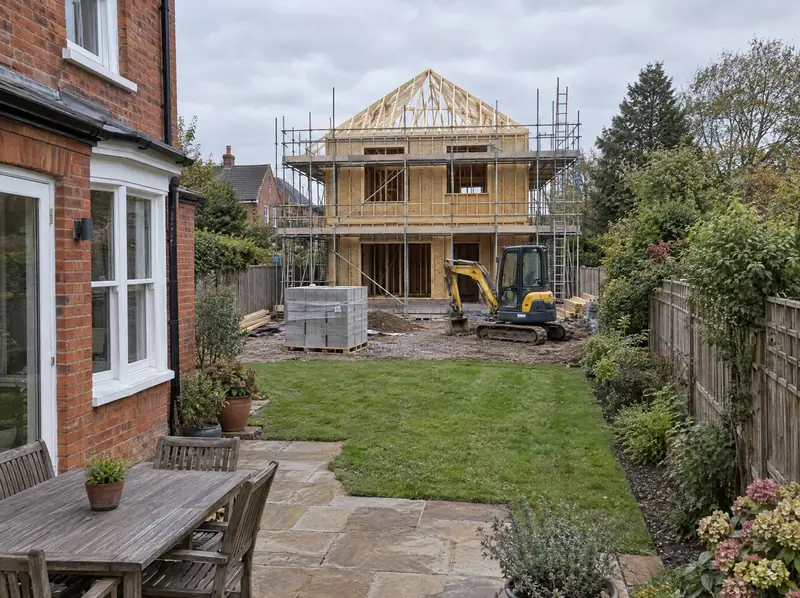
In Scunthorpe, applications for a new home in a garden are decided by North Lincolnshire Council, which weighs them against the council’s Local Plan and national policy. Officers look at access, privacy, daylight, parking, bins, drainage and how much garden is left for each house, and neighbours can comment during consultation.
We read the local policies and any design guidance before drawing a line, and check the planning history of nearby plots for decisions that show how the council has applied them. If the policy picture is uncertain, pre-application advice lets us test the scheme with officers before the formal application goes in.
The next steps, locally
If your Scunthorpe plot already has planning permission, we begin by checking the approved drawings and conditions against the site. Some permissions need detailed design, discharge of conditions or a minor amendment before they can be built. We then prepare the technical drawings, arrange Building Regulations approval and the warranty, apply for utility connections and give you a written quote to build.
Free plot appraisal
We check the title plan, access, constraints and planning policy from our desk, talk the plot through with you, and visit if it looks viable. There’s no cost and no obligation.
Survey and design
A measured survey records levels, boundaries, trees and neighbouring windows. We then design a layout and house that suit the plot, the street and your budget, and decide whether pre-application advice is worth seeking.
Planning and approvals
We submit the planning application and manage it to a decision, then deal with conditions, Building Regulations approval, the structural warranty, any build-over agreement and the new utility connections.
Written quote and build
Once design and survey are complete you get a written quote. The build runs in stages — access and groundworks, foundations, frame and roof, fit-out and external works — with inspections at each key point.
Worth checking early
- Your own garden gets smaller and the new home will be visible from your house, so screening and separation matter for both homes.
- A build next door means months of noise, deliveries and contractors near your home; good planning reduces the disruption but doesn’t remove it.
- Planning can be refused, and money spent on surveys, design and the application isn’t recovered if it is — which is why we start with an appraisal.
Your questions, answered for Scunthorpe
Do new homes in Scunthorpe need a structural warranty?
If the house will ever be sold or mortgaged, in practice yes. Mortgage lenders usually expect a 10-year structural warranty on a new home, though some accept an architect’s or surveyor’s certificate, and a warranty provider inspects the work at stages during the build, so it has to be in place before construction starts. Building control approval is separate and also required; a buyer’s solicitor will ask for both.
Will I pay Community Infrastructure Levy on a new home in Scunthorpe?
Only if North Lincolnshire Council has adopted a Community Infrastructure Levy charging schedule; not every council has. Where it applies, it can be charged on a new home of any size. A self-build exemption exists for people building a home to live in, but it must be claimed before work starts, so we check the position at design stage.
How close can a new house be to my own in Scunthorpe?
There’s no single national distance. Many councils use separation guides of around 21 metres between facing back windows and around 12 to 15 metres between a back window and a blank side wall, but the guidance used by North Lincolnshire Council decides. Window positions, ground levels, roof shape and screening all affect what is acceptable, which is why we survey before we design.
Can I build a house in my Scunthorpe garden and then sell it?
Yes. You keep the land while the home is built, then sell the finished house. Before building starts, the plot should be given its own title through a transfer of part at HM Land Registry, and if your house is mortgaged your lender must agree to release the plot. Selling a home you’ve built can change your tax position, so take advice from a tax adviser first.
Other options in Scunthorpe
- Joint venture on your garden plot
- Corner and side plots
- Sell subject to planning
- Garage courts and yards
- Garden plot option agreement
- Sell part of your garden