
- Planning authority
- West Suffolk Council
- Postcodes
- IP32, IP33
- Noon sun, 21 March
- About 38°
- Shadow from a 5 m eaves line
- About 6.5 m
- Planning plan
- Local Plan
- County
- Suffolk
Bury St Edmunds: light, access and policy
Access is where a garden plot anywhere in IP32 and IP33 tends to succeed or fail. A new drive needs enough width for cars, clear visibility where it meets the road, and enough distance from neighbouring windows to keep noise and headlights in check.
Policies in the council’s Local Plan, along with any highways advice the council receives, decide the detail for your address. We measure the gap beside your house on the first visit, and if it’s too tight for a home that can be approved and built safely, we’ll tell you before any design fees are spent.
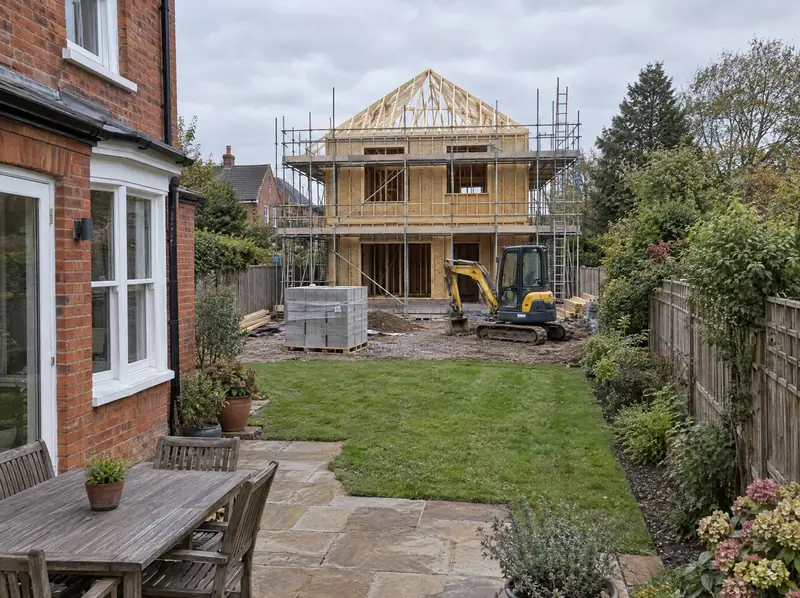
How we’d take it forward in Bury St Edmunds
Once you ask for an appraisal of your Bury St Edmunds garden, we start with the paperwork: the title plan, any covenants, flood maps, tree and conservation designations, and planning decisions on nearby plots. A short call follows, then a site visit if the plot passes the desk check. You get our straight view of what’s realistic and what happens next, with no obligation to go further.
Free plot appraisal
We check the title plan, access, constraints and planning policy from our desk, talk the plot through with you, and visit if it looks viable. There’s no cost and no obligation.
Survey and design
A measured survey records levels, boundaries, trees and neighbouring windows. We then design a layout and house that suit the plot, the street and your budget, and decide whether pre-application advice is worth seeking.
Planning and approvals
We submit the planning application and manage it to a decision, then deal with conditions, Building Regulations approval, the structural warranty, any build-over agreement and the new utility connections.
Handover
You receive the completion certificate, warranty documents, Energy Performance Certificate, manuals and utility details, so the new home is ready to move into, let or put on the market.
Worth checking early
- Planning can be refused, and money spent on surveys, design and the application isn’t recovered if it is — which is why we start with an appraisal.
- Building and selling a new home can change your tax position compared with selling only your house; take advice from a tax adviser first.
- You fund the build and carry the cost risk; ground conditions, sewer diversions or supply upgrades found later can move the price.
Questions about garden plots in Bury St Edmunds
How close can a new house be to my own in Bury St Edmunds?
There’s no single national distance. Many councils use separation guides of around 21 metres between facing back windows and around 12 to 15 metres between a back window and a blank side wall, but the guidance used by West Suffolk Council decides. Window positions, ground levels, roof shape and screening all affect what is acceptable, which is why we survey before we design.
How long does planning take for a new home in a Bury St Edmunds garden?
The statutory period for deciding a minor application, such as a single new home, is 8 weeks from the date the council receives a valid application, in both England and Wales. In practice many applications take longer, and the council may ask you to agree an extension in writing. Surveys and design before submission add time, and conditions may need approving afterwards.
Can I build a house in my Bury St Edmunds garden and then sell it?
Yes. You keep the land while the home is built, then sell the finished house. Before building starts, the plot should be given its own title through a transfer of part at HM Land Registry, and if your house is mortgaged your lender must agree to release the plot. Selling a home you’ve built can change your tax position, so take advice from a tax adviser first.
Can the new home in my Bury St Edmunds garden connect to the main sewer?
Usually, yes, but the route and depth decide how easily. The new home needs its own foul connection, agreed with the water company, and gravity drainage is simplest where the sewer sits lower than the new floor. If it doesn’t, a pumped connection may be needed. Where a public sewer runs under your garden, a build-over agreement or diversion may also be required.
Other options in Bury St Edmunds
- Garden plot option agreement
- Tandem and landlocked plots
- Joint venture on your garden plot
- Planning promotion for your garden plot
- Large rear gardens
- Corner and side plots