
- Planning authority
- Gwynedd Council
- Postcodes
- LL53
- Noon sun, 21 March
- About 37°
- Shadow from a 5 m eaves line
- About 6.6 m
- Planning plan
- LDP
- County
- Gwynedd
How it plays out in Pwllheli
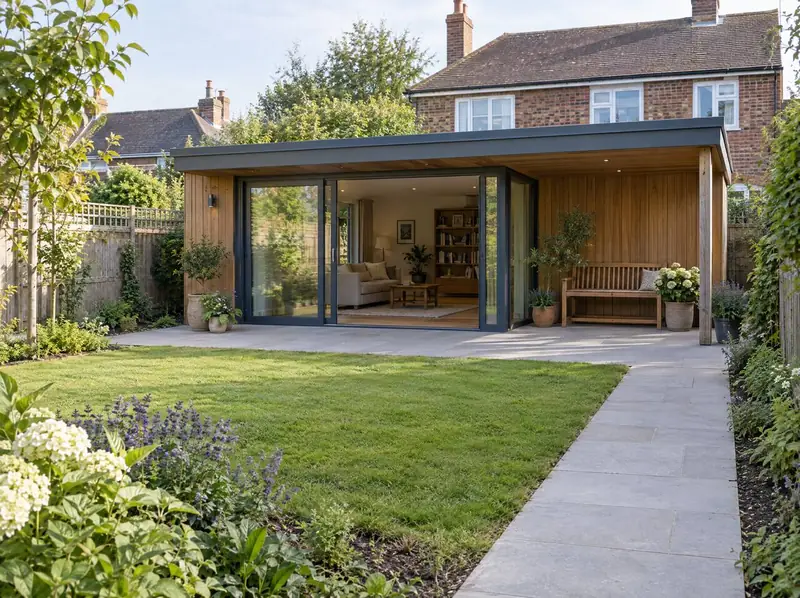
How the two households will live together shapes the planning case as much as the drawings do. If your parent will eat with you, share the garden and rely on you day to day, an annexe is the natural fit, and that is what Gwynedd Council will expect the application to describe. If your son or daughter will run their own home, pay their own bills and perhaps sell up one day, it is a separate dwelling and will be assessed against the council’s Local Development Plan (LDP) as a new house. For a family in LL53, we help set that out clearly from the start.
From first call to decision
The next step is a conversation, by phone or through the form, about your garden in Pwllheli and who the new home is for. We check access, title, the main planning constraints and any CIL position for your address, then tell you whether an annexe, a separate home or neither looks realistic. If neither does, we’ll say so and explain why.
Free plot appraisal
We look at your plot, access and the planning picture from the desk, talk through who will live in the new home, and visit if it looks viable. There’s no cost and no obligation.
Annexe or separate home
We set out both routes for your plot, covering what each means for planning, ownership, council tax, CIL and VAT, so you can decide with your family and advisers before design starts.
Survey and design
A measured survey, then a design built around the person moving in: step-free routes, a ground-floor bedroom if needed and privacy for both households. You get a written quote after design and survey.
Planning and approvals
We prepare and submit the planning application and manage it with the council, which makes the decision. Before work starts, approval under the Building Regulations as they apply in Wales is in place and any CIL exemption has been claimed.
Worth checking early
- A separate home needs its own garden, parking, bins and access, so it needs more land than an annexe.
- An annexe tied by planning condition usually can’t be sold or let separately, which limits flexibility later.
- Planning is the council’s decision, and an annexe is not a way round the rules that apply to a new house.
Pwllheli: questions to ask
How much garden do I need for a family home in Pwllheli?
There’s no fixed figure. A single-storey annexe close to the house can work on a smaller plot than a separate dwelling, which needs its own garden, parking and access. What matters is whether Gwynedd Council can be satisfied on privacy, daylight and the space left for both homes. The free appraisal gives you a first view based on your plot’s actual shape and access.
Is CIL payable on a family home in Pwllheli?
Only if Gwynedd Council has adopted the Community Infrastructure Levy, which its website will confirm, and we check it for you during the appraisal. Where it applies, self-build and residential annexe exemptions exist, but both must be claimed before work starts and can be withdrawn if the home is sold or let within three years of completion.
Can you design a home in Pwllheli for a relative who uses a wheelchair?
Yes. The design can include a level approach and threshold, turning space in each room, a wet room, wider doors and worktops at a usable height. Where Gwynedd Council requires a particular access standard through planning, the design meets it; otherwise it’s your choice how far to go. Input from your relative’s occupational therapist is well worth having.
Can I reclaim VAT on a family annexe in Pwllheli?
Often not. HMRC’s guidance gives an annexe that can’t be used or sold separately from the main house as an example of work that can’t be zero-rated, and the DIY housebuilders refund scheme asks the same question. A separate dwelling is usually treated differently. Take advice from a tax adviser before you settle the planning route, because the wording of the permission matters.
Other options in Pwllheli
- Plot feasibility and design
- Bungalows on large plots
- Build a new home in your garden
- Corner and side plots
- Planning promotion for your garden plot
- Sell part of your garden