
- Planning authority
- Durham County Council
- Postcodes
- DL4, DL5
- Noon sun, 21 March
- About 35°
- Shadow from a 5 m eaves line
- About 7.0 m
- Planning plan
- Local Plan
- County
- County Durham
The local picture in Newton Aycliffe
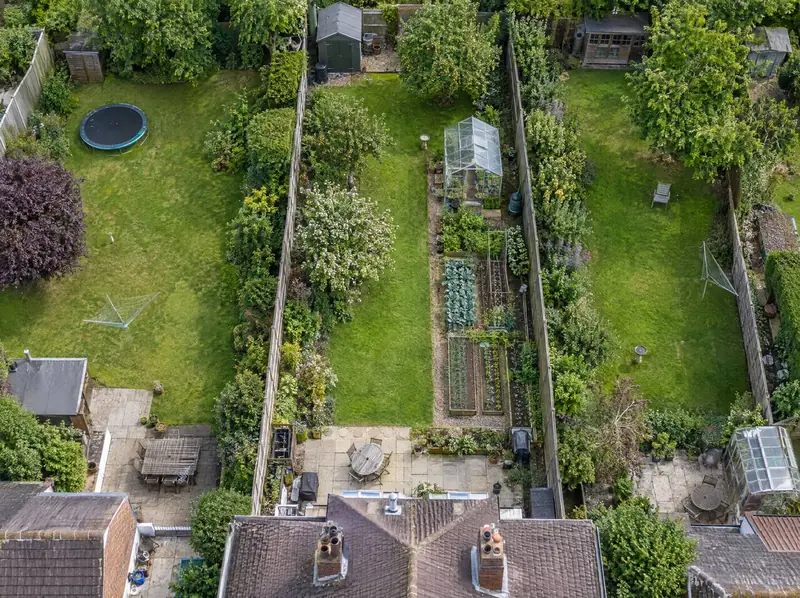
Overshadowing is often the deciding issue in a long garden. At midday on 21 March the sun in Newton Aycliffe stands about 35° above the horizon, so a typical two-storey eaves line throws a shadow of roughly 7.0 m. In midwinter the noon sun is only about 12° up and shadows stretch around three times as far.
That’s why the gap between a new home and neighbouring gardens matters, and why a lower roof, or a home set further from the boundary, can make a scheme acceptable. We check the shadows on your actual plot rather than relying on rules of thumb.
From first call to decision
Once you’ve had the free appraisal, nothing moves without your say-so. For a sale, terms are agreed in writing before you sign anything. For a build, design and survey come first and the quote follows. In both cases the planning application goes to Durham County Council, which consults your neighbours before deciding. Small schemes often take a few months from submission, and surveys or design changes can add more.
Free plot appraisal
We look at your garden using maps, the title plan and the planning history around you, then talk it through with you. If it looks workable we arrange a site visit. There’s no cost and no obligation.
Measure and test the layout
We check depth, the width of the way in, levels, trees, drains and what lies behind, then sketch what could realistically fit: one home, two, or nothing worth pursuing, before anyone pays for an application.
Planning application
We prepare the drawings and reports, usually take pre-application advice, and submit. The council consults neighbours and decides. Small schemes often take a few months from submission, longer if surveys or amendments are needed.
Sale or build
If you sell, your solicitor handles the transfer of part and your lender’s release of the plot. If you build, we give a written quote after design and survey, then build and hand over the new home.
Worth checking early
- Cars passing beside your house to reach the new home bring noise and headlights; screening helps but doesn’t remove it.
- Neighbours are consulted and may object. The council decides, and a carefully designed scheme can still be refused.
- A shorter garden changes how your own house feels to live in and may affect what it is worth.
Your questions, answered for Newton Aycliffe
How long does planning take for a garden home in Newton Aycliffe?
It varies. Small schemes often take a few months from submission to decision, and longer if surveys, amendments or extra consultation are needed. Pre-application advice and early surveys add time at the start but can save time later. We won’t promise a date, because the council sets the pace.
Will my neighbours in Newton Aycliffe get a say?
Yes. The council consults neighbours on planning applications, and they can comment or object. Their comments are weighed alongside policy, but objections alone don’t decide the outcome. A layout that respects privacy, light and access usually gives neighbours less to worry about, so we design with them in mind.
Can I build a house in my back garden in Newton Aycliffe?
Possibly, if the garden is deep enough, has a safe way in and a new home wouldn’t harm the neighbours or the character of the street. A new separate home always needs planning permission, and Durham County Council makes the decision. A free appraisal will tell you whether your garden is worth taking further.
How do I find out if my Newton Aycliffe garden is big enough for a house?
Ask for a free garden plot appraisal. We measure depth and the width of the way in, check what lies behind, look at levels, trees and drainage, and compare your garden with your council’s separation and garden-size guidance. Size alone rarely settles it, because access and neighbours’ privacy matter just as much.
Other options in Newton Aycliffe
- Sell subject to planning
- Plot feasibility and design
- Build a home for family in your garden
- Bungalows on large plots
- Garage courts and yards
- Garden plot option agreement