
- Planning authority
- Mole Valley District Council
- Postcodes
- KT18, KT21, KT22, KT23
- Noon sun, 21 March
- About 39°
- Shadow from a 5 m eaves line
- About 6.2 m
- Planning plan
- Local Plan
- County
- Surrey
How it plays out in Leatherhead
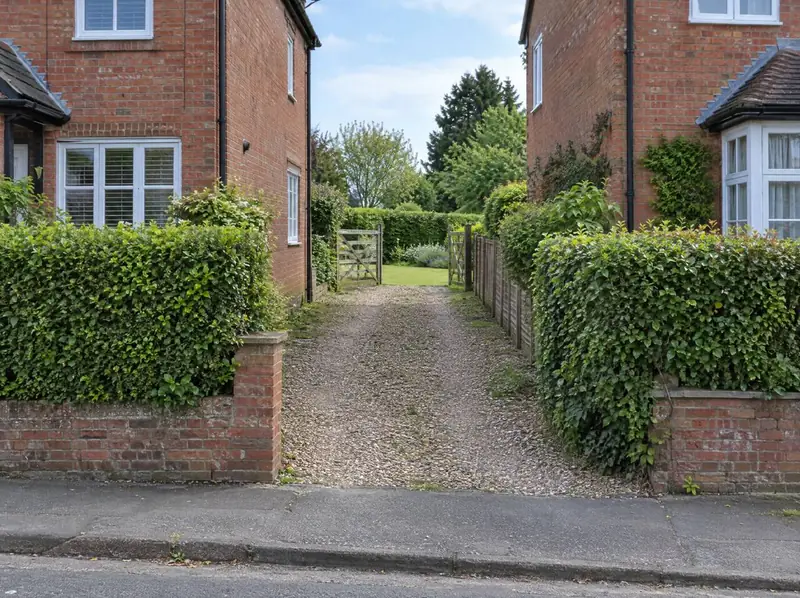
Access to land behind homes in KT18, KT21, KT22 and KT23 can differ from one street to the next: a side drive, a garage with a gap beside it, a back lane, or nothing at all. That is why we measure the actual route rather than relying on a map.
Mole Valley District Council will consult neighbours on any application, and the people living along the drive are the ones most affected. A layout that keeps cars away from their windows, with a fence or planting alongside, usually answers the strongest objections before they’re made.
What happens next in Leatherhead
Once you get in touch about land in Leatherhead, we look at the title plan and any rights of way from the desk, then talk it through with you. If the access looks workable, we visit and measure the route, including the junction with the road. You get a plain account of the options before any planning work starts.
Free plot appraisal
We start with the access, not the plot: title plans, rights of way, the width on the ground and the route to the road. It’s a desktop check and a conversation, with a site visit if it looks viable, at no cost.
Title and access check
With your solicitor we confirm who owns every strip between the plot and the road, what rights already exist and whether they cover a new home. Any ransom strip or missing right shows up at this stage.
Secure the way in
If a right of way needs widening, a strip needs buying or a neighbour needs to come in, we agree the approach with you and negotiate it, so the terms are settled before planning money is spent.
Planning application
We design a layout that answers the access, privacy and neighbour questions councils ask about tandem and backland plots, then apply. The council consults neighbours and decides, and the decision is always the council’s.
Worth checking early
- Access is usually the deciding factor on these plots, so a large plot with a poor way in may not be a building plot at all.
- Long or narrow drives can mean extra cost for sprinklers, passing places, lighting or a bin collection point.
- A right of way that has served a garage or field for years may not legally cover a new house.
Leatherhead: questions to ask
Could my neighbour and I in Leatherhead share one new access?
Often, yes. If both your gardens are long, combining them can give one shared drive and a better layout than either garden alone. Each owner keeps their house, and a written agreement sets out how the value is shared fairly.
How do I find out if a lane behind my Leatherhead home is a public road?
The highway authority keeps a list of streets maintained at public expense, and anyone can inspect it free of charge. If the lane isn’t on it, it’s probably private, and you’ll need to know who owns it and whether your title gives a vehicle right of way that would cover a new home.
Can I build behind my house in Leatherhead if the only way in is my drive?
Possibly. That would be a tandem layout, with the new home behind yours sharing your drive. Mole Valley District Council will look at the effect of cars passing your house, privacy, garden space and whether it suits the area. Fire and bin access also need checking. The decision is the council’s, and a good design improves the odds.
Is a sprinkler system needed for a home at the end of a long drive in Leatherhead?
It may be. In England, where a fire engine can’t get within 45 metres of all points inside the home, other measures, often sprinklers, may be accepted if building control and the fire service agree. In Wales, every new house needs sprinklers anyway. Building control decides what’s needed for the specific layout.
Other options in Leatherhead
- Corner and side plots
- Build a home for family in your garden
- Bungalows on large plots
- Sell subject to planning
- Planning permission for a garden plot
- Combine gardens with your neighbours