
- Planning authority
- Tameside Metropolitan Borough Council
- Postcodes
- SK16
- Noon sun, 21 March
- About 37°
- Shadow from a 5 m eaves line
- About 6.8 m
- Planning plan
- Local Plan
- County
- Greater Manchester
How it plays out in Dukinfield
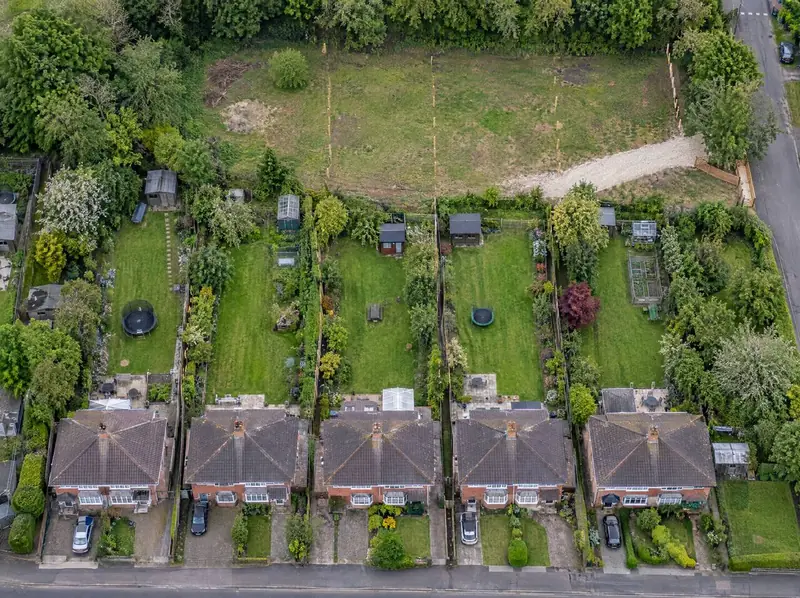
Shadow is one reason combined gardens in Dukinfield often work better. On 21 March the midday sun reaches roughly 37°, enough for a 5 m eaves line to shade about 6.8 m of ground, and by midwinter, at about 13°, the shade runs much further.
On one narrow garden, a new home can end up close to the houses on every side. On a combined site, the new homes can sit towards the middle, with gardens around them, and the shadows they cast fall mostly on their own land.
From first call to decision
To start, send us the addresses of the gardens involved in Dukinfield, or just your own if the neighbours haven’t been asked yet. We run a free desk-based check of the titles, access options and planning position, then explain in writing whether a combined scheme looks realistic before anyone talks to the neighbours in detail.
Free appraisal of the combined land
We look at all the titles together, the possible access points, the surrounding homes and the planning policies that apply, then explain whether a combined scheme looks realistic and roughly what it might allow.
Meet the neighbours
We meet the owners together or separately, explain how the scheme and the routes work, and answer questions. We don’t approach your neighbours without your agreement, and nobody is committed at this stage.
One planning application
We prepare and submit a single application for the whole site, with one shared access and a layout designed around all the existing homes. The council decides it, and nobody can promise the result.
Completion and shares paid
When the site is sold with planning, or bought by us as agreed, each owner transfers their part, and the proceeds are divided through the solicitors exactly as the collaboration agreement sets out.
Worth checking early
- Planning is still the council’s decision; a combined scheme is often stronger, but it can still be refused.
- The owner of the access garden will live beside a shared road, which is why that garden often receives an extra share.
- Several owners have to agree, so a combined scheme usually takes longer to set up than a single plot.
Your questions, answered for Dukinfield
What if one neighbour in Dukinfield changes their mind?
Before signing, they can simply step back, and we see whether the scheme still works without their garden. After signing, the agreements decide what happens, and they usually bind whoever owns the house next. Your solicitor will check those clauses carefully.
Does each Dukinfield owner keep their own house and garden?
Yes. Each owner keeps their house and an agreed garden for it. Only the land behind is transferred, as a transfer of part at HM Land Registry. New boundaries and fencing for each house are agreed as part of the design.
Can neighbours in Dukinfield combine their back gardens for new homes?
Yes, where the gardens adjoin and there’s a workable access. Each owner keeps their house, the land behind is planned as one site, and a collaboration agreement sets out how the value is shared. Tameside Metropolitan Borough Council decides any planning application on its merits.
Will Tameside Metropolitan Borough Council prefer a combined scheme to single plots in Dukinfield?
It often gives the council a better scheme to assess, with one proper access and more space between homes. But every application is judged on its merits against the council’s Local Plan, and the decision is the council’s. We test the layout against its policies before applying.
Other options in Dukinfield
- Garage courts and yards
- Corner and side plots
- Large rear gardens
- Bungalows on large plots
- Joint venture on your garden plot
- Sell subject to planning