
- Nation
- England
- National planning policy
- NPPF
- Planning authorities
- 9
- City
- Stoke-on-Trent
What to know in Staffordshire
Pre-application advice can save months on a garden plot. Many councils offer it, usually for a fee, and a written response from a planning officer shows early whether the principle of a new home is acceptable and what the council wants changed. On a conditional sale we normally arrange and fund this before submitting. It isn’t binding on the council, and it doesn’t replace the formal application, but it often shapes the drawings, and it helps both sides judge whether the long-stop date gives enough room.
Planning authorities covering Staffordshire include Cannock Chase District Council, East Staffordshire Borough Council, Lichfield District Council, Newcastle-under-Lyme Borough Council, South Staffordshire Council, Stafford Borough Council, Staffordshire Moorlands District Council, Stoke-on-Trent City Council, Tamworth Borough Council.
How it works
Free plot appraisal
We check your title, access, planning history and local policy from our desk, then talk it through with you. If a new home looks realistic, we visit the garden and tell you which route we think suits it best.
Heads of terms
We set out the price or price formula, what counts as satisfactory permission, the long-stop date, how any planning costs are treated and who pays which fees. You see all of it before instructing a solicitor.
Exchange of conditional contracts
Both solicitors agree the contract and the plan of the plot. On exchange, both sides are bound, subject to the planning condition, and our contract is noted on your title so the plot can’t be sold elsewhere.
Planning application
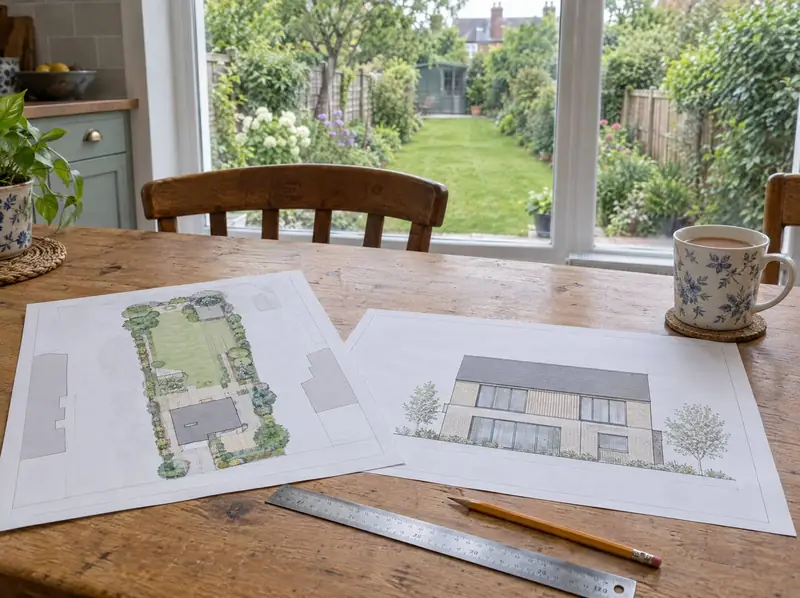
We commission the surveys, prepare the drawings, seek pre-application advice where useful and submit the application, normally at our cost. You see the plans before they go in, and the council makes the decision.
Completion, or you keep your land
Once a satisfactory permission is granted and any challenge period has passed, the sale completes within the agreed time and the plot gets its own title. If permission is refused and the contract ends, the land stays yours.
Subject to planning in towns across Staffordshire
- Stoke-on-Trent
- Newcastle-under-Lyme
- Burton upon Trent
- Cannock
- Tamworth
- Stafford
- Lichfield
- Kidsgrove
- Burntwood
- Rugeley
- Leek
- Great Wyrley
- Biddulph
Questions about subject to planning in Staffordshire
What is a long-stop date on a sale subject to planning in Staffordshire?
It is the last date by which a satisfactory planning permission must be granted. If none arrives by then, the contract ends and you keep your land. It is agreed at the start and should allow time for surveys, one application and, where sensible, a resubmission or appeal.
Which councils decide applications for garden plots in Staffordshire?
Each address falls under one local planning authority, and in Staffordshire the authorities include Cannock Chase District Council, East Staffordshire Borough Council, Lichfield District Council, Newcastle-under-Lyme Borough Council, South Staffordshire Council and other councils. Every one of them works to its own Local Plan alongside the NPPF, and some add guidance specifically on garden development, so we shape each scheme around the policies of the council that will judge it.
What surveys might a garden plot in Staffordshire need for planning?
Commonly a measured survey, a tree survey and a preliminary ecology check, plus drainage and sometimes flood risk work. Some ecology surveys can only be done at certain times of year, which affects the timetable. On a sale subject to planning, we normally commission and fund these as part of the application.
Do I need my own solicitor to sell a plot in Staffordshire?
Yes, always. Your solicitor checks the contract, deals with the transfer of part at HM Land Registry and asks your mortgage lender to release the plot if the house is mortgaged. On option and promotion agreements we cover your reasonable legal fees, with the cap agreed in heads of terms before work starts.