
- Planning authority
- North East Lincolnshire Council
- Postcodes
- DN31, DN32, DN33, DN34, DN41
- Noon sun, 21 March
- About 36°
- Shadow from a 5 m eaves line
- About 6.8 m
- Planning plan
- Local Plan
- County
- Lincolnshire
How it plays out in Grimsby
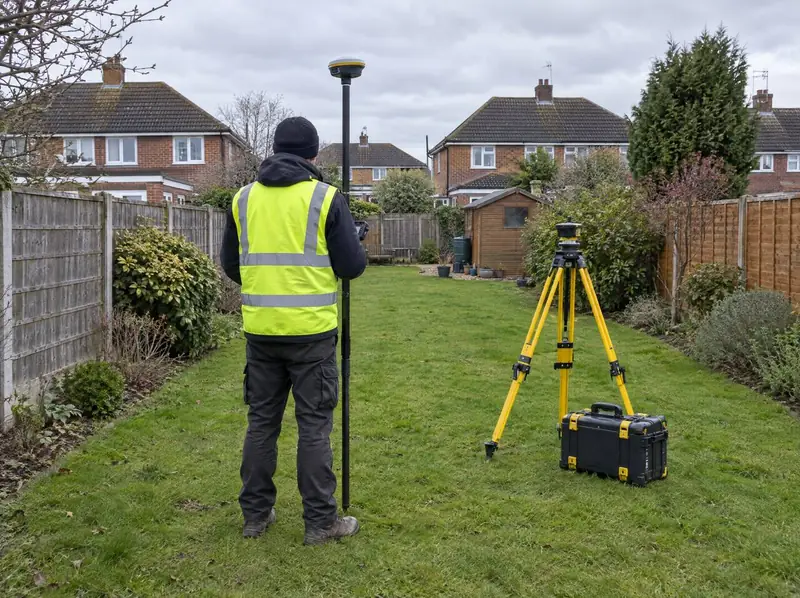
Daylight is one of the first things North East Lincolnshire Council will test on a garden scheme, so we test it first too. At midday on 21 March the sun over Grimsby sits about 36° above the horizon, and a typical two-storey eaves line around 5 m high throws a shadow of roughly 6.8 m. In late December the noon sun reaches only about 13°, so winter shadows run roughly three times longer. Plotting both on the measured survey shows where a new home can stand without darkening the gardens and rooms around it.
How we’d take it forward in Grimsby
Here’s how feasibility starts in Grimsby. You tell us about the plot, by phone or through the form, and we carry out a free desktop appraisal of access, title plan and planning context. If it looks viable we visit. If you want to go further, we send a written scope and quote for survey, constraints check and capacity study, and nothing starts until you agree.
Free plot appraisal
A desktop look at your plot, access, title plan and the planning picture, plus a conversation about what you want. If it looks viable we visit. There’s no cost and no obligation at this stage.
Scope and written quote
If you want to go further, we set out which surveys and checks your plot needs and what they will cost, in writing. Nothing is commissioned until you have agreed the scope and the price.
Survey and constraints check
A measured survey of the plot and its surroundings, then a check of the title, services, trees, flood risk and heritage designations, so the design starts from facts rather than guesses.
Feasibility report and options
A clear yes, no or maybe, the reasons behind it, and the routes open to you: apply for planning, build, sell or partner. You decide what happens next, with no obligation to use us for it.
Worth checking early
- Title problems such as covenants, ransom strips or missing rights of way can take time and money to resolve.
- Some ecology surveys can only be done at certain times of year, which can affect the programme.
- A feasibility study can end in a no; finding that out early costs far less than a refused application.
Questions about garden plots in Grimsby
How do I know if my garden in Grimsby is big enough for a house?
Size alone won’t tell you. What matters is whether there is a workable access, enough distance from neighbours’ windows, room for gardens, parking and bins for both homes, and nothing on the title or in policy that rules it out. A feasibility study checks each of those for your plot. The first stage, a free plot appraisal, gives you an early view.
Can I get pre-application advice on a garden plot in Grimsby?
Usually, yes. Most councils offer pre-application advice, and many charge a fee for it. North East Lincolnshire Council’s website sets out its current arrangements, including how to apply, what to send and how long a response usually takes. We can prepare the information and attend any meeting for you. The advice isn’t binding, but it is a useful test before a full application.
Is my Grimsby garden in a flood zone or conservation area?
Both are public information. Flood zones are shown on the flood maps for planning in England, and North East Lincolnshire Council publishes its conservation area boundaries and the listed buildings in its area. We check these as part of the free appraisal, along with Tree Preservation Orders, because each one changes what a scheme needs to show.
Can you check the title deeds on my Grimsby property?
Yes. We obtain the title register and title plan from HM Land Registry and read them for restrictive covenants, rights of way, easements and any mortgage charge. If something needs a legal opinion, we flag it so your solicitor can advise. Title issues are far better found during feasibility than halfway through a planning application or a sale.
Other options in Grimsby
- Tandem and landlocked plots
- Bungalows on large plots
- Corner and side plots
- Planning permission for a garden plot
- Garage courts and yards
- Combine gardens with your neighbours