
- Nation
- England
- National planning policy
- NPPF
- Planning authorities
- 11
- County town
- Guildford
Surrey: the planning picture
Under the National Planning Policy Framework (NPPF), councils weigh the character of an area, neighbours’ living conditions and the quality of design when judging homes in gardens. Each council in Surrey then adds its own detail in the council’s Local Plan and the council’s design guide or supplementary planning document. A capacity study turns those policies into measurements on your plot: separation distances, garden sizes, parking and building heights. Many councils work to roughly 21 metres where rear windows face each other, but the council’s own guide decides, so we check the right one.
Planning authorities covering Surrey include Elmbridge Borough Council, Epsom and Ewell Borough Council, Guildford Borough Council, Mole Valley District Council, Reigate and Banstead Borough Council, Runnymede Borough Council, Spelthorne Borough Council, Surrey Heath Borough Council, Tandridge District Council, Waverley Borough Council, Woking Borough Council.
How it works
Free plot appraisal
A desktop look at your plot, access, title plan and the planning picture, plus a conversation about what you want. If it looks viable we visit. There’s no cost and no obligation at this stage.
Scope and written quote
If you want to go further, we set out which surveys and checks your plot needs and what they will cost, in writing. Nothing is commissioned until you have agreed the scope and the price.
Survey and constraints check
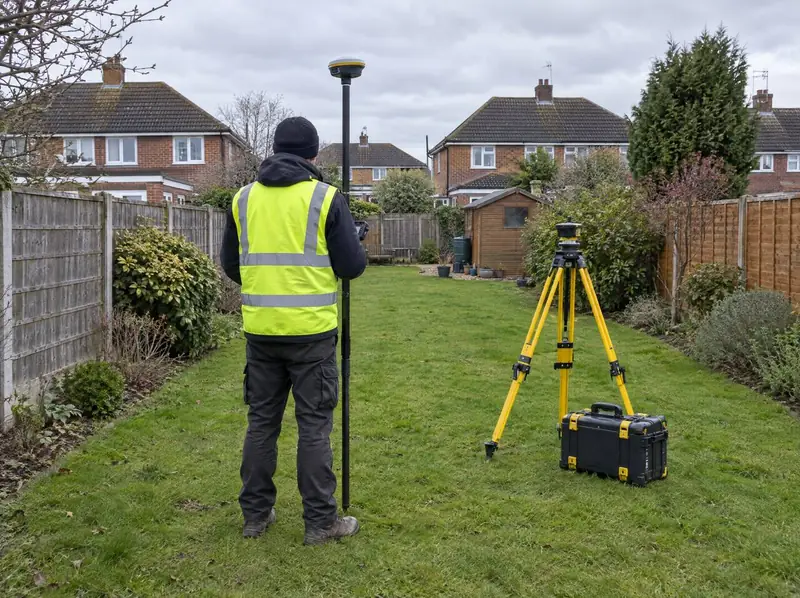
A measured survey of the plot and its surroundings, then a check of the title, services, trees, flood risk and heritage designations, so the design starts from facts rather than guesses.
Access and capacity study
We test each workable route in and the number, size and position of homes the plot could hold, against separation distances, garden space, parking, bins and daylight for neighbours.
Concept designs and pre-application
Sketch layouts and simple elevations for the strongest options. Where it will help, we take one to the council for pre-application advice before anything is submitted.
Feasibility report and options
A clear yes, no or maybe, the reasons behind it, and the routes open to you: apply for planning, build, sell or partner. You decide what happens next, with no obligation to use us for it.
Feasibility and design in towns across Surrey
- Woking
- Guildford
- Esher
- Redhill
- Staines-upon-Thames
- Banstead
- Leatherhead
- Ewell
- Farnham
- Epsom
- Camberley
- Egham
- Sunbury-on-Thames
- Ashford, Surrey
- Walton-on-Thames
- Godalming
- Reigate
- Horley
- Caterham
- Weybridge
- East Molesey
- Dorking
- Haslemere
- Cobham
- Chertsey
Questions about feasibility and design in Surrey
Is pre-application advice available in Surrey?
Most councils offer it, usually for a fee, and publish their arrangements online. It gives you a planning officer’s written view on the principle and design of a scheme before you apply. It isn’t binding, but on a finely balanced garden plot it often shows what the council will focus on.
How long does feasibility take for a plot in Surrey?
Often a few weeks, sometimes a couple of months. It depends on surveyor availability, whether title documents or specialist surveys are needed, and how long the council takes to respond if you ask for pre-application advice. Some ecology surveys can only be done at certain times of year.
Which councils decide garden schemes in Surrey?
The local planning authority for your address decides. In this area that includes Elmbridge Borough Council, Epsom and Ewell Borough Council, Guildford Borough Council, Mole Valley District Council, Reigate and Banstead Borough Council and other councils. Each applies the National Planning Policy Framework (NPPF) alongside its own Local Plan and design guidance, so the tests for a garden scheme can differ from one council to the next. We check the policies that apply to your plot.
Can neighbours in Surrey combine their gardens?
Yes. Putting two or more adjoining back gardens together can allow one shared access and a better layout than separate plots. Each owner keeps their house. The owners usually sign a collaboration agreement, with an equalisation clause so that value is shared fairly even though only one garden provides the access. Each household should take its own legal advice.