
- Planning authority
- Medway Council
- Postcodes
- ME3, ME4, ME7, ME8
- Noon sun, 21 March
- About 39°
- Shadow from a 5 m eaves line
- About 6.3 m
- Planning plan
- Local Plan
- County
- Kent
What the council will look at in Gillingham
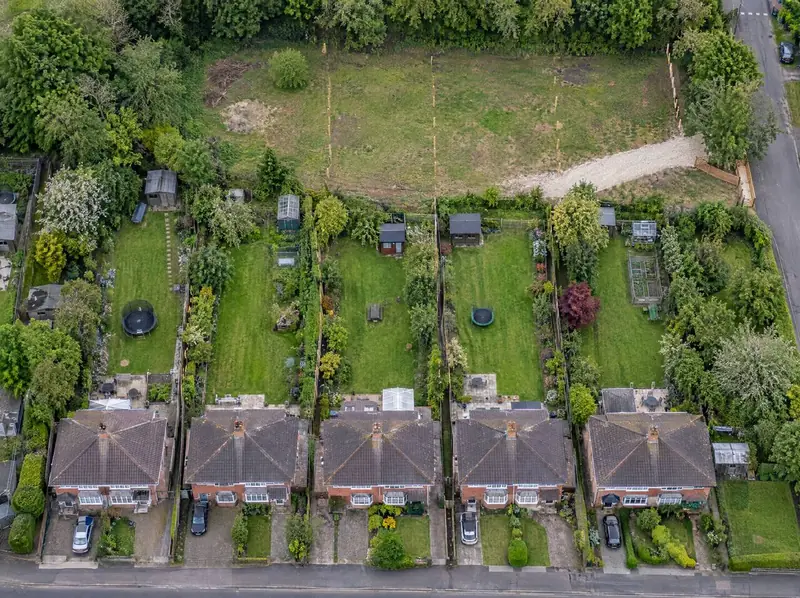
Shadow is one reason combined gardens in Gillingham often work better. On 21 March the midday sun reaches roughly 39°, enough for a 5 m eaves line to shade about 6.3 m of ground, and by midwinter, at about 15°, the shade runs much further.
On one narrow garden, a new home can end up close to the houses on every side. On a combined site, the new homes can sit towards the middle, with gardens around them, and the shadows they cast fall mostly on their own land.
The next steps, locally
Nothing happens without every owner’s agreement. If you’re in Gillingham and think the gardens on your side of the street could work together, call us or use the form. We’ll look at the land first, tell you plainly whether it’s worth pursuing, and only then discuss approaching the other owners, with your say-so and in the way you prefer.
Free appraisal of the combined land
We look at all the titles together, the possible access points, the surrounding homes and the planning policies that apply, then explain whether a combined scheme looks realistic and roughly what it might allow.
Meet the neighbours
We meet the owners together or separately, explain how the scheme and the routes work, and answer questions. We don’t approach your neighbours without your agreement, and nobody is committed at this stage.
Collaboration agreement
Each owner’s own solicitor reviews the documents, and everyone signs a collaboration agreement alongside the sale, option or promotion agreement. Mortgage lenders are asked to consent early, and the agreements are usually protected on each title.
One planning application
We prepare and submit a single application for the whole site, with one shared access and a layout designed around all the existing homes. The council decides it, and nobody can promise the result.
Worth checking early
- Planning is still the council’s decision; a combined scheme is often stronger, but it can still be refused.
- Tax depends on each owner’s circumstances, so each should take advice from a tax adviser.
- If the garden providing the access drops out before signing, the whole scheme may not work.
Your questions, answered for Gillingham
Who gets more if one garden in Gillingham provides the access?
Usually the owner of the access garden receives an extra agreed share, because their land makes the scheme possible and their house is most affected by passing cars. The exact method is agreed by everyone in the collaboration agreement before planning starts.
What if one neighbour in Gillingham changes their mind?
Before signing, they can simply step back, and we see whether the scheme still works without their garden. After signing, the agreements decide what happens, and they usually bind whoever owns the house next. Your solicitor will check those clauses carefully.
Do we each need a solicitor for a combined scheme in Gillingham?
Yes. Each owner has different interests, a different title and possibly a mortgage, so each needs independent advice. On option and promotion agreements we cover each owner’s reasonable legal fees up to the cap agreed in the heads of terms.
Does each Gillingham owner keep their own house and garden?
Yes. Each owner keeps their house and an agreed garden for it. Only the land behind is transferred, as a transfer of part at HM Land Registry. New boundaries and fencing for each house are agreed as part of the design.
Other options in Gillingham
- Plot feasibility and design
- Sell subject to planning
- Build a new home in your garden
- Tandem and landlocked plots
- Bungalows on large plots
- Planning promotion for your garden plot