
- Planning authority
- Leeds City Council
- Postcodes
- LS20
- Noon sun, 21 March
- About 36°
- Shadow from a 5 m eaves line
- About 6.9 m
- Planning plan
- Local Plan
- County
- West Yorkshire
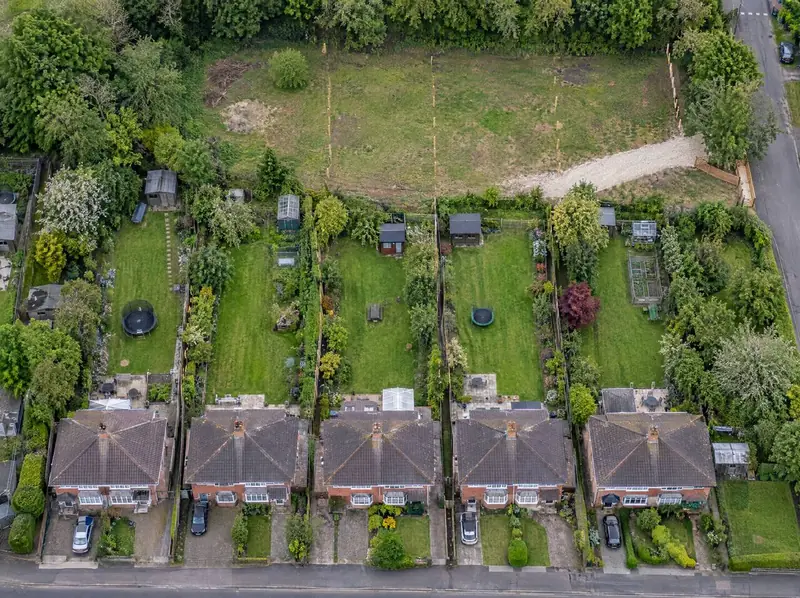
What shapes a plot in Guiseley
Back gardens in LS20, as anywhere, tend to be divided by fences, hedges and the odd tree, and a combined scheme has to work with all of them. Old boundary hedges may be habitat worth keeping, and mature trees may need an assessment before anything is designed.
We map these features across all the gardens at once, so the layout keeps what matters and the application to Leeds City Council shows how trees and wildlife have been considered. Doing it across the whole site is simpler and cheaper than doing it garden by garden.
The next steps, locally
Once the group is interested, we meet the owners, together or one by one, and set out the routes and how equalisation would work. Heads of terms follow. Each owner’s own solicitor reviews the collaboration agreement and the sale, option or promotion documents, and lenders are asked to consent early. Then the single application goes to Leeds City Council.
Free appraisal of the combined land
We look at all the titles together, the possible access points, the surrounding homes and the planning policies that apply, then explain whether a combined scheme looks realistic and roughly what it might allow.
Meet the neighbours
We meet the owners together or separately, explain how the scheme and the routes work, and answer questions. We don’t approach your neighbours without your agreement, and nobody is committed at this stage.
Collaboration agreement
Each owner’s own solicitor reviews the documents, and everyone signs a collaboration agreement alongside the sale, option or promotion agreement. Mortgage lenders are asked to consent early, and the agreements are usually protected on each title.
One planning application
We prepare and submit a single application for the whole site, with one shared access and a layout designed around all the existing homes. The council decides it, and nobody can promise the result.
Worth checking early
- Every owner’s mortgage lender, title and covenants have to be dealt with, and one problem can hold up everyone.
- Tax depends on each owner’s circumstances, so each should take advice from a tax adviser.
- Planning is still the council’s decision; a combined scheme is often stronger, but it can still be refused.
Guiseley: questions to ask
Will Leeds City Council prefer a combined scheme to single plots in Guiseley?
It often gives the council a better scheme to assess, with one proper access and more space between homes. But every application is judged on its merits against the council’s Local Plan, and the decision is the council’s. We test the layout against its policies before applying.
Who gets more if one garden in Guiseley provides the access?
Usually the owner of the access garden receives an extra agreed share, because their land makes the scheme possible and their house is most affected by passing cars. The exact method is agreed by everyone in the collaboration agreement before planning starts.
Can neighbours in Guiseley combine their back gardens for new homes?
Yes, where the gardens adjoin and there’s a workable access. Each owner keeps their house, the land behind is planned as one site, and a collaboration agreement sets out how the value is shared. Leeds City Council decides any planning application on its merits.
How many neighbours in Guiseley need to take part?
As few as two can be enough. What matters is that the gardens taking part make a workable site and that one of them provides access to the road. We tell you which gardens are essential and which would simply improve the scheme.
Other options in Guiseley
- Planning permission for a garden plot
- Tandem and landlocked plots
- Sell subject to planning
- Plot feasibility and design
- Bungalows on large plots
- Planning promotion for your garden plot