
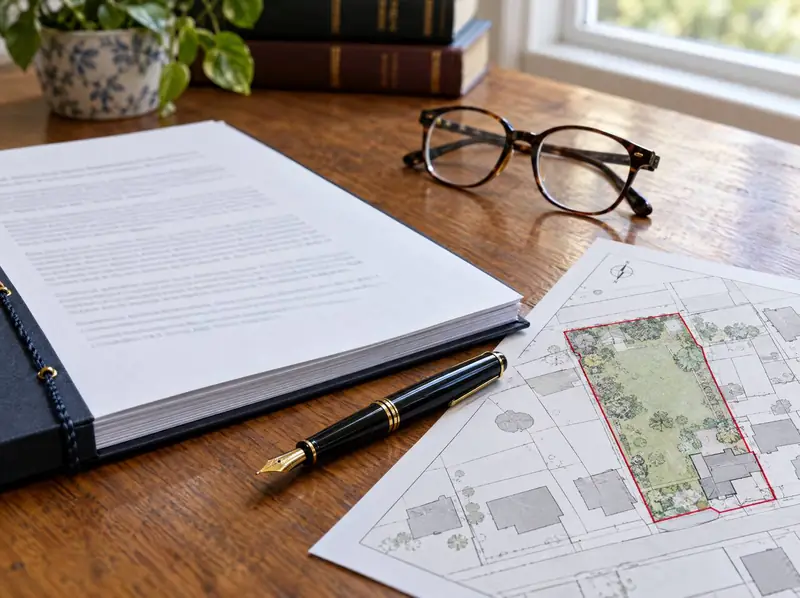
- Planning authority
- Arun District Council
- Postcodes
- BN16, BN17
- Noon sun, 21 March
- About 39°
- Shadow from a 5 m eaves line
- About 6.1 m
- Planning plan
- Local Plan
- County
- West Sussex
Littlehampton: light, access and policy
When we look at a garden in BN16 and BN17 for a possible option, we measure the things that create uncertainty: the width and ownership of the access, the distance to neighbouring windows, the trees and their roots, and the levels across the plot. Those findings decide how long the option period needs to be and what the agreement asks of us.
If access depends on a neighbour, the option holds your plot while we negotiate. If Arun District Council is likely to want a revised scheme, the period allows for it.
The next steps, locally
Here is what happens in Littlehampton. A conversation first, then a desk check, then a visit if the plot looks promising. We put proposed terms in writing, without obligation, and you take advice on them with your legal fees covered within the agreed cap. Nothing is binding until you sign the option agreement itself, and the appraisal costs nothing.
Free plot appraisal
We look at your title, the access, the planning history and the policies that apply, then tell you honestly whether an option, an outright sale or a conditional contract fits your plot best. It costs you nothing.
Heads of terms
We set out the option period, the price formula and minimum price, any option fee, our planning obligations and the cap on your reasonable legal fees, which we cover. Nothing is binding at this stage.
Sign the option
Your solicitor and ours agree the option agreement and the plan of the plot. Once it is signed, the option is noted on your title, and you carry on living in your house and using the garden as normal.
Planning work
We commission surveys, design the scheme and apply for planning, keeping you updated and showing you the drawings before submission. The council decides; if it refuses, the agreement sets out whether we revise, reapply or appeal.
Worth checking early
- Deductions agreed at the start, such as planning costs, reduce what you receive, so check them closely.
- With a market value formula, the final price isn’t known until the option is exercised.
- We have the right to buy, not a duty, so a sale isn’t certain even after a long wait.
Questions about garden plots in Littlehampton
Could my neighbours in Littlehampton be part of the same option scheme?
Yes. Where neighbouring gardens together would make a better scheme, each owner can grant an option on their own land, and an agreement between the owners can share the outcome fairly. It needs careful drafting and everyone’s agreement, and it often produces a scheme Arun District Council is more likely to approve.
How long would an option on my Littlehampton garden last?
The period is agreed at the start and should match the planning task: long enough for surveys, an application and, where sensible, a revised scheme or appeal, but no longer. On a single garden it is usually much shorter than on farmland. Any extension should be tied to specific events.
Who decides planning on an option plot in Littlehampton?
The decision belongs to Arun District Council, which will weigh the scheme against the council’s Local Plan and the National Planning Policy Framework (NPPF). Our job during the option period is to put in the strongest application the plot allows and answer the council’s questions. The agreement sets out what happens if permission is refused.
Do I still own my garden in Littlehampton during an option?
Yes. An option is a right to buy, not a sale, so the land stays yours until we exercise the option and the sale completes. You carry on using the garden, and the option is noted on your title so the plot can’t be sold elsewhere while it runs.
Other options in Littlehampton
- Sell part of your garden
- Build a home for family in your garden
- Tandem and landlocked plots
- Combine gardens with your neighbours
- Garage courts and yards
- Bungalows on large plots