
- Planning authority
- Cambridge City Council
- Postcodes
- CB1, CB2, CB3, CB4, CB5
- Noon sun, 21 March
- About 38°
- Shadow from a 5 m eaves line
- About 6.4 m
- Planning plan
- Local Plan
- County
- Cambridgeshire
Cambridge: light, access and policy
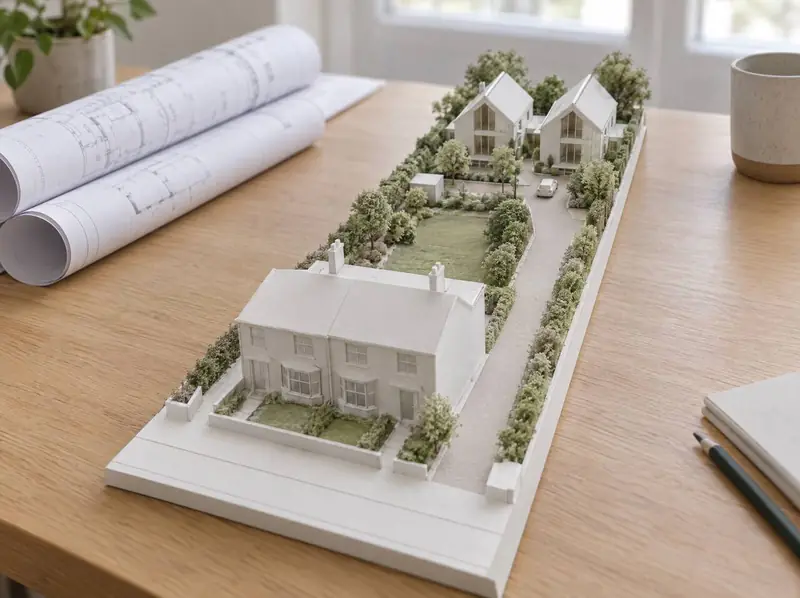
At noon on 21 March the sun over Cambridge sits about 38° above the horizon, so a two-storey eaves line around 5 m high casts a shadow of roughly 6.4 m. By 21 December, with the sun at about 14°, that shadow is far longer. Cambridge City Council will weigh how a new home affects daylight and sunlight to your house and the gardens next door.
Under promotion we test this before applying, because a refusal on overshadowing costs time even though it doesn’t cost you money. Moving the new home, lowering the eaves or turning the roof can make the difference.
The next steps, locally
Nothing is signed until you’ve seen the heads of terms and taken advice. Call us or use the form with your Cambridge address, a rough idea of where the garden runs, and whether neighbours might join in. We’ll check the title, access and planning history first, then tell you plainly whether promotion, a sale subject to planning or another route suits your plot.
Free plot appraisal
We check your title plan, access, the surrounding gardens and the policies in the council’s Local Plan as a desktop exercise, then talk it through with you. If it looks viable, we visit. No cost and no obligation.
Heads of terms
We set out the deal in writing: the term, how our fee works, the cap on planning costs we can recover, the minimum price, the marketing approach and the cap on your reasonable legal fees that we cover.
We apply for planning
We commission the surveys and drawings, take pre-application advice where it helps, submit the application and deal with the council’s questions. You pay nothing at this stage, and the decision is the council’s.
Completion and payout
On completion, sale costs, our capped planning costs and our fee come out of the proceeds in the order the agreement sets. The balance is paid to you through your solicitor.
Worth checking early
- The plot’s price isn’t known until it’s marketed with permission; it depends on location, size, access and the permission itself.
- On a single small plot, fixed costs and our fee take a bigger share of the sale price than on a larger site.
- You’ll live next to whatever is built, so the layout, windows and new boundary affect your house too.
Cambridge: questions to ask
How long does planning promotion take for a garden in Cambridge?
It usually takes longer than a straight sale. Design and surveys often take a few months, then Cambridge City Council needs time to decide, and marketing and conveyancing follow. The council’s workload, extra reports and any appeal drive the timing, so we give a realistic range after the appraisal.
How is a promoted garden plot in Cambridge sold?
After permission, an agent agreed with you markets the plot to builders, developers and self-builders. You see the offers and approve the buyer. The plot can’t be sold below the agreed minimum price without your written consent, and any offer from us has to stand up against the open market.
Can you look at my garden in Cambridge before I commit to anything?
Yes. The plot appraisal is free and carries no obligation. We start with a desktop check of your title, access and the planning policies that apply, then talk it through with you. If the plot looks viable, we arrange a site visit before any heads of terms are drafted.
What happens if planning is refused for my garden in Cambridge?
You keep your land and owe nothing for planning, because our costs are only recovered from a sale with planning. Within the term we may revise the scheme and reapply, or appeal if the grounds are strong. If there’s no realistic route to permission, the agreement ends.
Other options in Cambridge
- Tandem and landlocked plots
- Plot feasibility and design
- Planning permission for a garden plot
- Sell part of your garden
- Large rear gardens
- Build a new home in your garden