
- Planning authority
- Reading Borough Council
- Postcodes
- RG1, RG4, RG6, RG30, RG31
- Noon sun, 21 March
- About 39°
- Shadow from a 5 m eaves line
- About 6.3 m
- Planning plan
- Local Plan
- County
- Berkshire
Before you decide in Reading
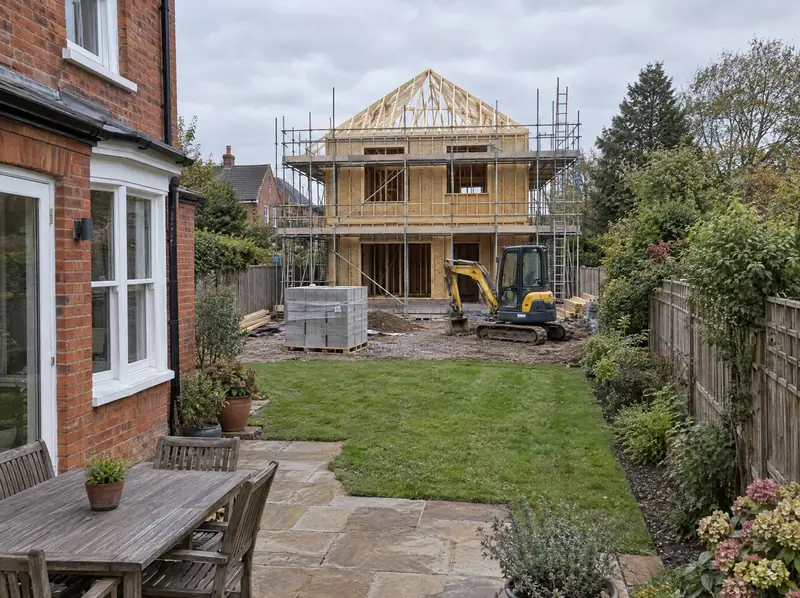
Construction on a Reading garden plot runs to a programme agreed once Reading Borough Council has issued permission and any pre-commencement conditions have been dealt with. Groundworks and foundations come first; the shell and roof follow, then glazing, internal trades and, last of all, the drive and planting.
Weather matters. Around 21 December the sun in Reading climbs to only about 15° at midday, so winter days are short and wet ground slows the work. Where we can, we order the job so the house is weathertight before the worst months arrive.
From first call to decision
Once you ask for an appraisal of your Reading garden, we start with the paperwork: the title plan, any covenants, flood maps, tree and conservation designations, and planning decisions on nearby plots. A short call follows, then a site visit if the plot passes the desk check. You get our straight view of what’s realistic and what happens next, with no obligation to go further.
Free plot appraisal
We check the title plan, access, constraints and planning policy from our desk, talk the plot through with you, and visit if it looks viable. There’s no cost and no obligation.
Survey and design
A measured survey records levels, boundaries, trees and neighbouring windows. We then design a layout and house that suit the plot, the street and your budget, and decide whether pre-application advice is worth seeking.
Written quote and build
Once design and survey are complete you get a written quote. The build runs in stages — access and groundworks, foundations, frame and roof, fit-out and external works — with inspections at each key point.
Handover
You receive the completion certificate, warranty documents, Energy Performance Certificate, manuals and utility details, so the new home is ready to move into, let or put on the market.
Worth checking early
- You fund the build and carry the cost risk; ground conditions, sewer diversions or supply upgrades found later can move the price.
- Building and selling a new home can change your tax position compared with selling only your house; take advice from a tax adviser first.
- Your own garden gets smaller and the new home will be visible from your house, so screening and separation matter for both homes.
Questions about garden plots in Reading
Do new homes in Reading need a structural warranty?
If the house will ever be sold or mortgaged, in practice yes. Mortgage lenders usually expect a 10-year structural warranty on a new home, though some accept an architect’s or surveyor’s certificate, and a warranty provider inspects the work at stages during the build, so it has to be in place before construction starts. Building control approval is separate and also required; a buyer’s solicitor will ask for both.
Who decides planning for a garden house in Reading?
Reading Borough Council decides applications for addresses in Reading, using the council’s Local Plan, national policy and its own design guidance. Neighbours and consultees such as highways officers can comment, and the decision is made by the council’s planning officers or, where the rules allow, its planning committee. Pre-application advice from the council can help test a scheme before the formal application is submitted.
How long does planning take for a new home in a Reading garden?
The statutory period for deciding a minor application, such as a single new home, is 8 weeks from the date the council receives a valid application, in both England and Wales. In practice many applications take longer, and the council may ask you to agree an extension in writing. Surveys and design before submission add time, and conditions may need approving afterwards.
Can the new home in my Reading garden connect to the main sewer?
Usually, yes, but the route and depth decide how easily. The new home needs its own foul connection, agreed with the water company, and gravity drainage is simplest where the sewer sits lower than the new floor. If it doesn’t, a pumped connection may be needed. Where a public sewer runs under your garden, a build-over agreement or diversion may also be required.
Other options in Reading
- Garage courts and yards
- Planning permission for a garden plot
- Plot feasibility and design
- Tandem and landlocked plots
- Garden plot option agreement
- Combine gardens with your neighbours