
- Planning authority
- Flintshire County Council
- Postcodes
- CH5
- Noon sun, 21 March
- About 37°
- Shadow from a 5 m eaves line
- About 6.7 m
- Planning plan
- LDP
- County
- Clwyd
What shapes a plot in Hawarden
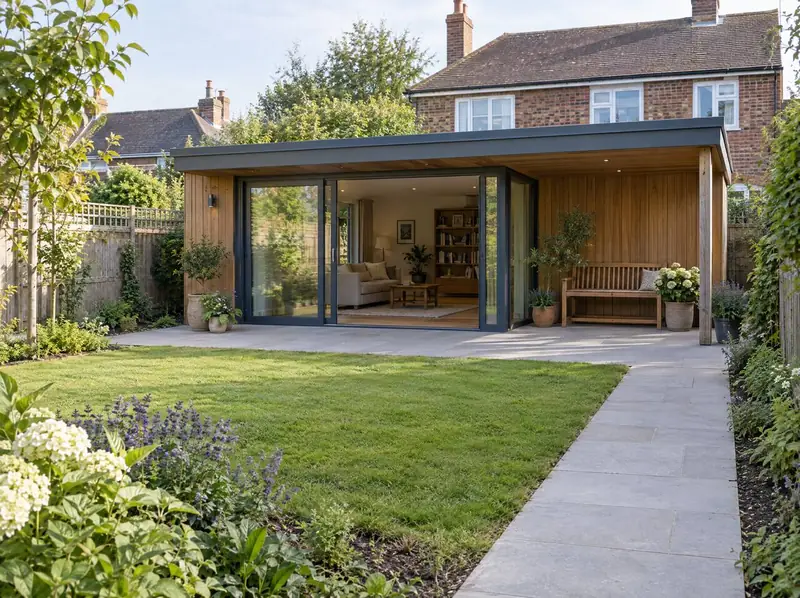
People living next door are consulted on every planning application, and across CH5 that applies to a family annexe just as much as to a new house. Their privacy, outlook and light carry real weight with Flintshire County Council. A design that keeps upper windows away from adjoining gardens, uses obscure glazing where it has to, and leaves a planted margin along the boundary gives the council fewer reasons to refuse. A quiet word with the people either side before the application goes in is often worthwhile too.
From first call to decision
The next step is a conversation, by phone or through the form, about your garden in Hawarden and who the new home is for. We check access, title, the main planning constraints and any CIL position for your address, then tell you whether an annexe, a separate home or neither looks realistic. If neither does, we’ll say so and explain why.
Free plot appraisal
We look at your plot, access and the planning picture from the desk, talk through who will live in the new home, and visit if it looks viable. There’s no cost and no obligation.
Survey and design
A measured survey, then a design built around the person moving in: step-free routes, a ground-floor bedroom if needed and privacy for both households. You get a written quote after design and survey.
Planning and approvals
We prepare and submit the planning application and manage it with the council, which makes the decision. Before work starts, approval under the Building Regulations as they apply in Wales is in place and any CIL exemption has been claimed.
Build and handover
We build while you carry on living next door, with access, deliveries and working hours agreed up front. At handover you get the completion certificate and the paperwork you’ll need for council tax, lenders and any VAT claim.
Worth checking early
- An annexe tied by planning condition usually can’t be sold or let separately, which limits flexibility later.
- CIL exemptions are lost if work starts before the claim is made, and can be withdrawn if the home is sold or let within three years.
- Planning is the council’s decision, and an annexe is not a way round the rules that apply to a new house.
Hawarden: questions to ask
Do I need planning permission for a granny annexe in Hawarden?
Yes, almost always for a detached annexe with its own kitchen, bathroom and bedroom. Flintshire County Council will treat it as accommodation linked to your home and will usually add a condition so it can’t be let or sold separately. A garden building used only as a home office or gym is a different matter, but sleeping and cooking take it beyond those allowances.
Who owns an annexe built in my Hawarden garden?
You do. An annexe stays on the title of your house and usually carries a planning condition tying it to the main home, so it can’t be transferred to the relative living in it. If a family member is paying towards it, record what they’ve put in and what happens on a sale in a written agreement drawn up by a solicitor.
How much garden do I need for a family home in Hawarden?
There’s no fixed figure. A single-storey annexe close to the house can work on a smaller plot than a separate dwelling, which needs its own garden, parking and access. What matters is whether Flintshire County Council can be satisfied on privacy, daylight and the space left for both homes. The free appraisal gives you a first view based on your plot’s actual shape and access.
How long will building work disrupt my home in Hawarden?
A single garden home usually takes several months on site, with the noisiest work, such as groundworks, drainage and heavy deliveries, concentrated near the start. We agree working hours, access and parking with you up front, and with the people next door where it affects them, so your household knows what each week will look like.
Other options in Hawarden
- Combine gardens with your neighbours
- Sell subject to planning
- Corner and side plots
- Garden plot option agreement
- Sell part of your garden
- Planning promotion for your garden plot