
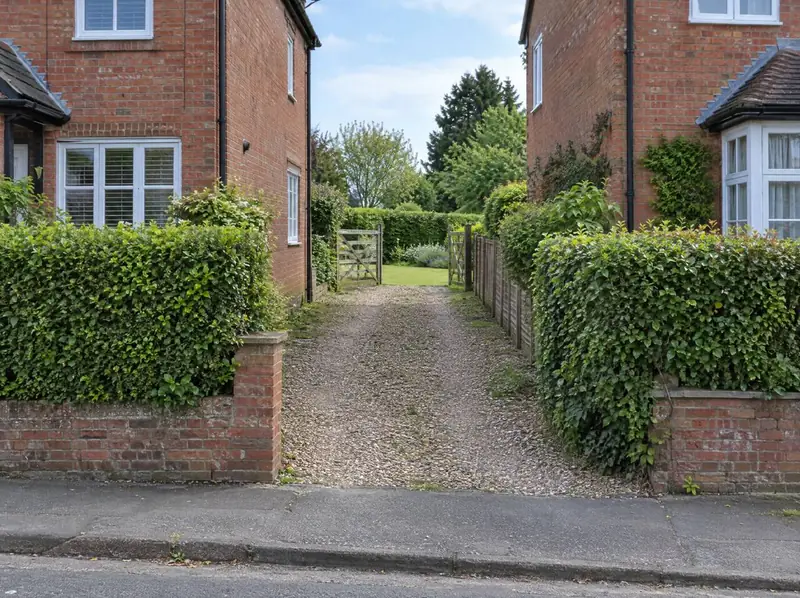
- Planning authority
- Canterbury City Council
- Postcodes
- CT1, CT2
- Noon sun, 21 March
- About 39°
- Shadow from a 5 m eaves line
- About 6.2 m
- Planning plan
- Local Plan
- County
- Kent
What the council will look at in Canterbury
A home placed behind another changes the light as well as the traffic. In Canterbury the sun peaks at roughly 39° in late March and barely 15° at the winter solstice, so shadows from even a modest building stretch a long way across a garden in the darker months.
That is why many tandem schemes use a single-storey or low-eaves design. It keeps upstairs windows from looking over neighbours and limits shadow. Canterbury City Council decides, and its own guidance on separation distances sets the gaps it expects.
From first call to decision
The first step is a free, no-obligation appraisal. For a Canterbury plot with a difficult way in, that means checking who owns each part of the route, what rights exist and how wide it is on the ground. If a neighbour or a ransom strip is involved, we agree an approach with you before contacting anyone.
Free plot appraisal
We start with the access, not the plot: title plans, rights of way, the width on the ground and the route to the road. It’s a desktop check and a conversation, with a site visit if it looks viable, at no cost.
Title and access check
With your solicitor we confirm who owns every strip between the plot and the road, what rights already exist and whether they cover a new home. Any ransom strip or missing right shows up at this stage.
Secure the way in
If a right of way needs widening, a strip needs buying or a neighbour needs to come in, we agree the approach with you and negotiate it, so the terms are settled before planning money is spent.
Planning application
We design a layout that answers the access, privacy and neighbour questions councils ask about tandem and backland plots, then apply. The council consults neighbours and decides, and the decision is always the council’s.
Worth checking early
- Planning permission gives no right to cross land you don’t own; the legal access has to be secured separately.
- Access is usually the deciding factor on these plots, so a large plot with a poor way in may not be a building plot at all.
- Buying out a ransom strip or a neighbour’s land costs money and time, and the other owner can say no.
Your questions, answered for Canterbury
Can I build behind my house in Canterbury if the only way in is my drive?
Possibly. That would be a tandem layout, with the new home behind yours sharing your drive. Canterbury City Council will look at the effect of cars passing your house, privacy, garden space and whether it suits the area. Fire and bin access also need checking. The decision is the council’s, and a good design improves the odds.
What if a neighbour in Canterbury owns the strip I need to cross?
Then you need their agreement, either to buy the strip or to grant a right of way over it. Terms are negotiated, often as a one-off payment or a share of the value the access creates. Both sides should take legal advice. We can make the approach with you.
Is a sprinkler system needed for a home at the end of a long drive in Canterbury?
It may be. In England, where a fire engine can’t get within 45 metres of all points inside the home, other measures, often sprinklers, may be accepted if building control and the fire service agree. In Wales, every new house needs sprinklers anyway. Building control decides what’s needed for the specific layout.
Do you buy landlocked land in Canterbury?
We can, where the access problem looks solvable. Any purchase is subject to survey, title and contract. If securing access would cost more than it’s worth, or the owner of the strip won’t deal, we tell you that early rather than wasting your time.
Other options in Canterbury
- Bungalows on large plots
- Planning permission for a garden plot
- Garage courts and yards
- Sell subject to planning
- Corner and side plots
- Large rear gardens