
- Planning authority
- Oxford City Council
- Postcodes
- OX1, OX3, OX4
- Noon sun, 21 March
- About 38°
- Shadow from a 5 m eaves line
- About 6.3 m
- Planning plan
- Local Plan
- County
- Oxfordshire
What shapes a plot in Oxford
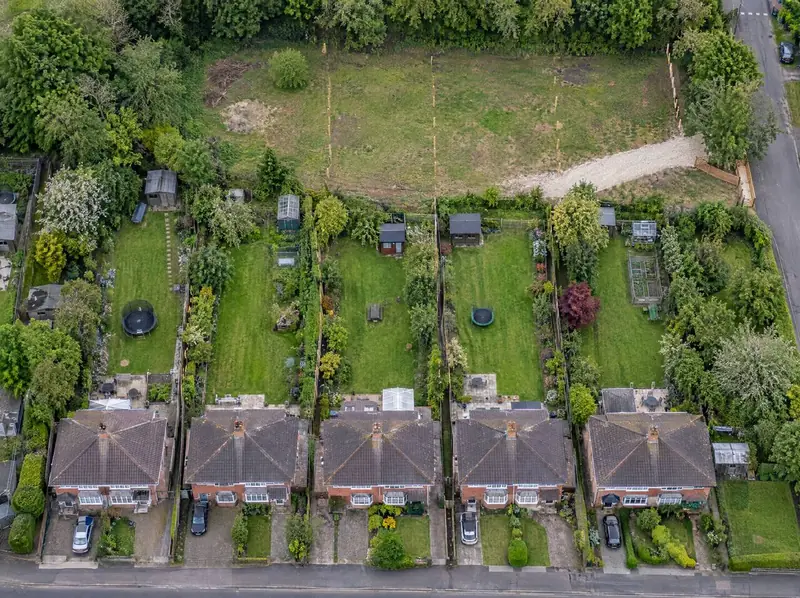
Before we suggest a combined scheme for homes in OX1, OX3 and OX4, we read what the council’s Local Plan says about garden land, design and parking, and we look at past decisions on similar sites nearby. Those tell us how the council has treated backland schemes before.
If policy points against building behind the houses, combining gardens won’t change that, and we’ll say so. If it supports well-designed schemes with proper access, a combined site is often the best way to meet that standard.
From first call to decision
To start, send us the addresses of the gardens involved in Oxford, or just your own if the neighbours haven’t been asked yet. We run a free desk-based check of the titles, access options and planning position, then explain in writing whether a combined scheme looks realistic before anyone talks to the neighbours in detail.
Free appraisal of the combined land
We look at all the titles together, the possible access points, the surrounding homes and the planning policies that apply, then explain whether a combined scheme looks realistic and roughly what it might allow.
Meet the neighbours
We meet the owners together or separately, explain how the scheme and the routes work, and answer questions. We don’t approach your neighbours without your agreement, and nobody is committed at this stage.
Agree how value is shared
Heads of terms set out the route, each owner’s share, any extra for the garden providing the access, what happens if someone drops out, and the cap on each owner’s reasonable legal fees where it applies.
Completion and shares paid
When the site is sold with planning, or bought by us as agreed, each owner transfers their part, and the proceeds are divided through the solicitors exactly as the collaboration agreement sets out.
Worth checking early
- Several owners have to agree, so a combined scheme usually takes longer to set up than a single plot.
- Tax depends on each owner’s circumstances, so each should take advice from a tax adviser.
- Every owner’s mortgage lender, title and covenants have to be dealt with, and one problem can hold up everyone.
Oxford: questions to ask
Who gets more if one garden in Oxford provides the access?
Usually the owner of the access garden receives an extra agreed share, because their land makes the scheme possible and their house is most affected by passing cars. The exact method is agreed by everyone in the collaboration agreement before planning starts.
Can neighbours in Oxford combine their back gardens for new homes?
Yes, where the gardens adjoin and there’s a workable access. Each owner keeps their house, the land behind is planned as one site, and a collaboration agreement sets out how the value is shared. Oxford City Council decides any planning application on its merits.
Will Oxford City Council prefer a combined scheme to single plots in Oxford?
It often gives the council a better scheme to assess, with one proper access and more space between homes. But every application is judged on its merits against the council’s Local Plan, and the decision is the council’s. We test the layout against its policies before applying.
How many neighbours in Oxford need to take part?
As few as two can be enough. What matters is that the gardens taking part make a workable site and that one of them provides access to the road. We tell you which gardens are essential and which would simply improve the scheme.
Other options in Oxford
- Sell part of your garden
- Planning promotion for your garden plot
- Planning permission for a garden plot
- Tandem and landlocked plots
- Build a home for family in your garden
- Garage courts and yards